Showing posts with label learning. Show all posts

Wednesday, April 29, 2015

Learning | Apronym and Kibosh

I stumbled across a new word today, while I was trying to look up the origin of another word.  It all started when I used the word "kibosh" in conversation recently. You know, as in, putting the kibosh on something, to stop it. I knew what it meant, from context, but I really had no idea where it came from. So I decided to look it up. 
The Oxford English Dictionary (Cake!)

from Pete Prodoehl's photostream on Flickr.com.


I would love to have this on my birthday cake!

I looked for kibosh in the Oxford English Dictionary. The OED is considered the best source for looking up word origins, but it wasn't much help this time. It declares the origin obscure (meaning nobody knows where the word originated,) but it also mentions that it could be Yiddish or Anglo-Hebraic. 

I decided to check our electronic databases. I didn't know if they would be any help, but I thought there might be an obscure article in a scholarly journal in there somewhere. So I went to Academic Search Premiere, and typed in "kibosh."  

That brought up too many news articles with headlines talking about putting the kibosh on things. 

I narrowed my results to scholarly journals. That cleared things up; instead of 66 articles, I had four. One of those four had a word in the title that I had never heard before: apronym. (The word kibosh was also in the article, as part of an apronym for BLOCKAGE; the article was not about the origin of kibosh.) 


Shoemaker in apron, holding his tools. (Cropped.)
from George Eastman House's photostream on Flickr.com.
No known copyright issues.
Never mind kibosh! 

I had to know more about apronym and its meaning. The word I accidentally found has nothing to do with the names of aprons. 

Apronym is a relatively new word; it is a portmanteau of the words a propos and acronym. (For a discussion of portmanteaus, just click on the above link to my 2013 post about them.)

Here's a link to the article where I found the word apronym. It gives some fun examples of apronyms, in which are acronyms that form a real word, with the words that form the acronym relating to the meaning of the word. For example, Seasonal Affective Disorder has an apronym of SAD. It might help to think of apronyms as plays on words, like puns.

Wednesday, April 8, 2015

Learning | Maya Angelou

Dr. Maya Angelou's estate has published a new book of her work, entitled The Complete Poetry.  

The book includes the poems we already know and love, like, "I Know Why the Caged Bird Sings," "And Still I Rise," and "Phenomenal Woman." 

It really is a book to be savored.  I've picked it up a dozen times since I checked it out yesterday. I open the book to a random spot to read a poem, maybe one I already know, or one that is new to me. I marvel at her ability to find the right words and rhythm, to conjure up images, moments, and moods.


Artistic interpretation of And Still I Rise:
LaSalle Mural (New Orleans)
from
Derek Bridges' photostream on Flickr.com.
Some rights reserved.

I was surprised and selfishly pleased to find it on the new book shelf at my branch. Most of you are aware that Dr. Maya Angelou has a Stockton connection; her mother, Vivian Baxter Johnson, lived here for many years. Dr. Angelou's books are especially popular in this neck of the woods.

I had heard of the book, but considering that this is National Poetry Month, and April 4 would have been her eighty-seventh birthday, AND there's a new United States Postal Service Forever stamp honoring this great lady, I really expected that The Complete Poetry of Maya Angelou would already be checked out.

Speaking of that postage stamp, if you are free on the morning of Saturday, April 11, you may wish to head over to the Maya Angelou Southeast Branch Library for a very special occasion. 

There will be a dedication ceremony for the Maya Angelou stamp at 11 a.m. 

The short ceremony will include artistic performances by students of
Aspire Rosa Parks Academy, Stockton. Refreshments will be available, and you will have the opportunity to purchase commemorative items related to the stamp, with an option for a special souvenir cancellation.

Need help finding the Maya Angelou Southeast Branch?  Here's a link to the branch's web page; you will find a link on that page with a map. The Maya Angelou Branch is located at 2324 Pock Lane, Stockton CA 95205. 


Wednesday, April 1, 2015

Learning | Peter Rabbit and Peter Cottontail

Have you wondered about the difference between Peter Rabbit and Peter Cottontail? I have, for far too long.


Poster: THE WORLD OF BEATRIX POTTER - PETER RABBIT
RHS Flower Show Tatton Park, Knutsford, Cheshire, England, UK.
I first became familiar with Peter Rabbit from the works of Beatrix Potter, who created a rabbit character named Peter back in 1902. In the book, The Tale of Peter Rabbit, Peter was a naughty little rabbit who almost got caught when he sneaked into Mr. MacGregor's garden. (He should have listened to his mother!)

In the story, Peter has siblings named Flopsy, Mopsy and Cottontail.  I think that means their surnames would be "Rabbit," just like Peter. You know, Flopsy Rabbit, Mopsy Rabbit, and Cottontail Rabbit.  

In any case, Flopsy, Mopsy and Cottontail Rabbit all listened when their mother told them to stay out of Mr. MacGregor's garden. But Peter did not obey her.


Mr. MacGregor's Garden,
from Hannah Swithinbank's photostream
on Flickr.com. Some rights reserved.


It's easy to understand why Peter wanted to eat lettuces, beans and radishes from Mr. MacGregor's garden. Just look at these pictures, from a re-creation of his garden at  Beatrix Potter's Hill Top Cottage in Sawrey, Cumbria, in England's Lake District.

Wouldn't it be fun to stroll around these gardens, and see the house where Beatrix Potter lived, when she wrote The Tale of Peter Rabbit? 

I think I need to add this to my bucket list.


Peter's Watering Can 1,
from Adam Russell's photostream on Flickr.com.
Some rights reserved.
Beatrix Potter books, from Jennifer LaSuprema's photostream
on Flickr.com Some rights reserved.

The Tale of Peter Rabbit was the first of Potter's wildy popular series of "Little Tales." I can remember how special I thought they were, when I was very small, to hold a little book that was just the right size for my tiny hands. 


Of course, Beatrix Potter's illustrations of cute little animals wearing human clothes hold a child's interest, too. According to the Beatrix Potter official website, one of her books is sold every four minutes!

This being Eastertide, I started thinking about a children's song heard this time of year: "Peter Cottontail." It was written in 1949 by the same team of songwriters that brought us "Frosty, the Snowman." Gene Autry recorded the song in 1950; sometimes the name of the song is listed as "Here Comes Peter Cottontail."

Image from page 200 of
"Mother West Wind 'Why' Stories,"
by Thornton W. Burgess,
illustrations in colour by Harrison Cady.
From Internet Archive Book Images' photostream on Flickr.com.
No known copyright restrictions.
I suspect that song is about another rabbit named Peter, created in 1910 by the American writer, Thornton W. Burgess.  

Peter Rabbit was one of many animal characters in Burgess' book, Old Mother West Wind. Later, Burgess wrote a book about him, called The Adventures of Peter Cottontail (available through Link+.)  

In that book, Peter Rabbit decides that his last name sounds too ordinary, so he chooses a name he thinks is fancier--"Cottontail."  By the end of the book, he decides he likes his original name and changes it back.  

Like Beatrix Potter, Burgess loved nature, and he mostly wrote stories about anthropomorphic animals. But he did not illustrate his own stories. Here is a picture from "Mother West Wind 'Why' Stories," illustrated by Harrison Cady.

If you would like to explore this subject in depth, SSJCPL has a nonfiction book for adults. If you would like to read it, you will first have to master its cumbersome, rambling, run-on title. 

It's called The History of The tale of Peter Rabbit : taken mainly from Leslie Linder's A history of the writings of Beatrix Potter together with the text and illustrations from the first privately printed edition.

Try saying that three times, very quickly, and Mr. MacGregor is your uncle!


Wednesday, March 25, 2015

Learning | Ook.

Sir Terry Pratchett passed away on March 12, 2015.  Readers around the world mourn the loss of the creator of the comic fantasy Discworld series. Discworld is a flat world that rests on the backs of four elephants; those elephants, in turn, are standing on the back of a giant turtle.  If you are able to accept that premise, and even laugh at it, you would probably enjoy reading books in the Discworld series.


0504 9757 Sir Terry Pratchett,
from Steve James' photostream on Flickr.com
Some rights reserved.
 My friend, Elsbeth, pointed out that there is no need to read Discworld books in the order that they were published. It's true. Different books satirize different aspects of the real world. (There are even parodies of the fantasy genre.) Various titles spoof tourism, war, bureaucracy, prejudice, jingoism, Ancient Egypt, opera, journalism...the list goes on and on. Characters recur in subsequent books, but there are always new characters. 


For instance, there is a certain librarian in the first two books, who works for Unseen University.  He is accidentally transformed into an orangutan in the second book.  He won't allow anybody to change him back (after all, he can climb up to the highest shelves with ease.) He recurs in many of the later books. 

You'll sometimes see a piece of luggage wander into the action at the most interesting moments. It wanders around because it's made of sapient pearwood (which is magical.) It can sprout hundreds of little legs, enabling it to run away very quickly. It has multiple functions--carrying its owner's luggage, and acting as a bodyguard. In the novel Sourcery, it is described as "half luggage, half homicidal maniac." (Note: SSJCPL no longer has any copies of Sourcery in its catalog. You'll need to get it from Link+.)

Pyramids, Discworld #7, from
 sdoble's photostream on Flickr.com.
Some rights reserved.
It seems as though there's a guild for everything in Ankh-Morpork, the large, bustling city that provides a setting in many of the Discworld books. 

There's even a guild for assassins. Here's a nice, juicy quote about the members of that guild, from Pyramids: 

"All assassins had a full-length mirror in their rooms, because it would be a terrible insult to anyone to kill them when you were badly dressed."

Pyramids is a good book to start with, if you haven't read anything else about Discworld.


"Pratchett is my hero..."
 from Robert N's photostream on Flickr.com.
Some rights reserved.


Most of Pratchett's books were written for an adult audience, but there is also a series for children ages 8 and up, called the Johnny Maxwell Trilogy.

Pratchett wrote a number of books for a teen audience. I am especially partial to the Tiffany Aching series.  You'll want to read those in order, to follow Tiffany's progress as she grows up; start with The Wee Free Men.


You may be wondering about the title of this blog post. When the Librarian at Unseen University became an orangutan, he lost all speech, except for "ook," and the occasional "eek." He communicates remarkably well, using different inflections for "ook." It might be "ook?" or "ook!" or "oooooook!"


Wednesday, March 18, 2015

Learning | Marginalia

Let's explore the subject of writing in books. Not writing books; taking a physical copy of a published work, and marking it in some way.  

Most of us have put our name on the flyleaf of a book we own; when I was a new reader and writer, I think I did that to every book I owned. I was proud of owning the books, but probably even more proud that I could express myself (in a very small way) in writing.

When I was older, I would underline (I'm not sure I was aware of highlighters yet, if they had been invented) important passages in books I was reading for English classes. (I'm not talking about school-owned books; I'm remembering the paperback copies of classic books, which I purchased.)

In tenth grade, my best friend, Roberta and I took this to a whole new level. That year, we had the same English teacher, Ms. Newman, but I was in the second period class, and Roberta was in the third period class. (Or maybe it was the other way around. We often mix ourselves up with each  other.)  

It was the year we read Julius Caesar.
Each of us had a paperback copy of the play. We were discussing it every day in class for what seemed like forever. Maybe it was a month? A few weeks? I don't know. I started out the usual way, underlining important phrases and noting important thoughts in the margins. 

Then, I think I started putting thought bubbles on the illustrations.  Two centurions were standing right next two each other, and I made one say,"Don't I know you from junior high school?"  

It was an inside joke.  I had recently been in a crowd at Mardi Gras, and I had heard one drag queen say that to another. They were both so heavily made up and gorgeously costumed, I wondered how the one guy had even recognized the other.  So the drawing of these centurions holding spears, wearing armor and helmets, struck me as a depiction of a similar situation.
Roman augur,
Image from page 246 of "The standard edition of the pictorial Shakspere" (1846)
From Internet Archive Book Images' photostream on Flickr.com.
No known copyright restrictions.


Roberta and I started exchanging our copies of Julius Caesar, as one of us ascended the stairs, and the other descended.  

Those Julius Caesars filled up with drawings, thought bubbles, fake footnotes at other comments. One of the real footnotes contained the phrase,"Elizabethan audiences delighted in such puns."  So we looked for more puns in the play, and added more footnotes. 
Just imagine the thought bubbles that could be added to this picture, or maybe a funny caption.
Image from page 237 of "Julius Caesar and the foundation of the Roman imperial system" (1894),
from Internet Archive Book Images' photostream on Flickr.com. No known copyright restrictions.

True to form, we keep forgetting where those Julius Caesars are, but we still occasionally get together and read them and laugh our heads off.

Today's word is marginalia. It simply means notes in the margin or margins of a book. That makes sense.  But I just had to look up the origin of the word margin, while I was at it. It comes from Latin, as many book terms do, and it originally meant the edge of a sea or lake. I like that. It makes me want to compare discovering marginalia in books to finding things washed up on the beach.

There's a new book out called Letter to a Future Lover: Marginalia, Errata, Secrets, Inscriptions, and Other Ephemera Found in Libraries. 
Author Ander Monson has gathered examples of all sorts of books that have been marked up in one way or another. This book is loaded with Monson's essays on a wide range of subjects, including errata, permanence, time, computer punch cards, and a dead poet. It's one of those books that are wonderful to open at any random page, and find a gem.

Have fun with marginalia! But, whatever you do, don't write in a book that belongs to somebody else, without their permission. And NEVER write in a library book. Please.

Thursday, March 12, 2015

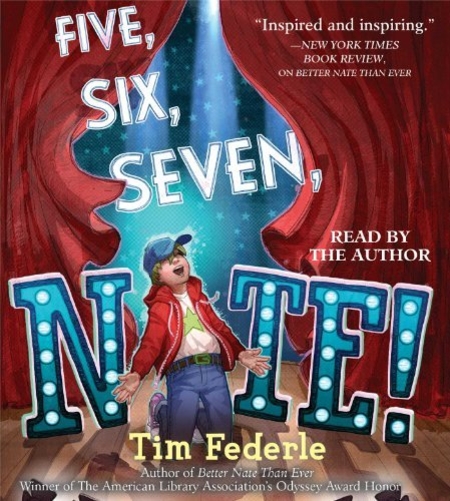
Learning | 5, 6, 7, Nate!


I spent my evenings this week listening to an audiobook for tweens. You know, tweens, those people who are no longer small children, but not quite teenagers yet (never mind not quite being adult yet.)  

The main characters in Five, Six, Seven, Nate! are thirteen years old.  The narrator of this story is Nathan (Nate) Foster, a theater geek who is leaving home to appear in his first Broadway musical. Okay, so he'll be playing Alien Number Seven, not actually starring in ET: The Musical, but, still! This could be his big break.

After Nate says goodbye to his best friend (and fellow theater nerd) Libby, he arrives on the first day of rehearsals to find that practically everybody else in the production has professional experience.

Five, Six, Seven, Nate gives us a glimpse into the behind-the-scenes production of a Broadway musical, and the large number of (often interesting) people involved in making a show happen.

I listened to the audio version of this book, because it was honored by the 2015 Odyssey Award committee. This award is given to the best audiobook produced for children and/or young adults available in English in the United States. The author of the book, Tim Federle, reads the book out loud in the audio version. He makes the character of Nate come alive.

I see that Five, Six, Seven, Nate! is the sequel to a book called Better Nate than Never. I'll be looking for that one and reading it soon. I hope there will be more books about Nate. He's such a likable character.


Saturday, March 7, 2015

Learning | Musketeers and Elites

This week, I've been reading a dystopian fantasy novel for teens. Marie Lu's The Young Elites takes place in a world where survivors of the Blood Plague are feared and ostracized. The king has an organization called The Inquisition, which aims to eliminate the malfettos, or survivors. 

These survivors are all marked in one way or another, with strange colorations of hair or skin. Adelina is one such survivor; she lost an eye to the plague, and her hair is now silver.  The story begins when Adelina is about to be executed for the murder of her abusive father; she quickly discovers that she is one of the rare malfettos with special powers--an elite. She finds herself joining The Daggers, a group of young elites who are using their powers to protect other malfettos from The Inquisition.


Cover image courtesy of LibraryThing.

You may remember that Marie Lu is the author of the Legend Series. The Young Elites is the first novel in a new series for teens.  It is recommended for ages 12 through 17.  

While I was reading The Young Elites, I was reminded of a classic series by Alexandre Dumas, The D'Artagnan Romances, including The Three Musketeers

Cover image courtesy of LibraryThing.
The iconic Musketeers have been featured in countless adaptations on the big and small screen.  D'Artagnan and his fellow Musketeers fight with swords, not superpowers, but I think people who like Alexandre Dumas' stories would like Lu's book. 

Wednesday, February 25, 2015

Learning | The Right Word: Roget and His Thesaurus

How many of you have enjoyed flipping through Roget's Thesaurus, looking for random groups of synonyms?  I think most of us used it for schoolwork, when looking for the right word to describe something, or trying not to use the same word over and over again in an essay. But I loved picking up the book and learning more about words and their relationships to other words. 

A 2015 Caldecott Honor book presents a similar pleasure, in the form of a children's picture book about the life of Peter Mark Roget.  

The Right Word: Roget and His Thesaurus by Jen Bryant and Melissa Sweet is a visual treasure trove of lists, synonyms, and facts.  It tells the tale of a shy young boy who loved to make lists.  Some of those lists turned into a book that most of us remember from our school days, Roget's Thesaurus

The The Right Word's pages are illustrated with watercolor, collage, and mixed media. They effectively draw the reader in, to explore, discover, and become inspired. This is clearly a book that holds interest, even after repeated readings. I saw one review that compared reading The Right Word to looking through an old curio cabinet!

The publisher of this book, Eerdmans Books for Young Readers, has a delightful video trailer for The Right Word on its YouTube Channel.  


Saturday, February 14, 2015

Learning | The Crossover is a Winner!

Last Monday, I read the latest Newbery Medal Winning book.  It took me only one day to read The Crossover by Kwame Alexander. This book is really different from the typical Newbery book; it is a novel written in verse. 

The book gets its title from a basketball maneuver that involves rapidly switching hands while dribbling the ball. Good players say they can make an opponent break his ankles, when they change sides suddenly.


Josh Defines Crossover in a Poem,
from
The Crossover
by Kwame Alexander


I must admit, when I first started reading the book, I wondered if I would like it. I don't have anything against basketball, but if the whole book was going to be about basketball, I wasn't sure it would hold my interest. 

I was mistaken.

There is a lot of basketball talk in this book, because Josh (the narrator) and his twin brother are basketball stars at their school. Basketball talent must be hereditary in their family; their father is a retired pro basketball player.  But there's so much more to this book. For example: 


  1. Josh is part of a loving family. But they are headed for some rough patches in this book, which test their bonds.  
  2. Josh loves words!  In between the poems that move the story along, there are poems about vocabulary words. 
  3. Basketball is a metaphor in this book.  Especially the term "crossover." Read the book. Think about this. Then tell me what you think about it.
  4. Josh's poems are so varied! Some of them have fun visual effects; some sound like lyrics from a song. Others are more like narratives.  I found myself wondering what I would find, whenever I turned a new page.
  5. Remember what I said about not being sure the book would hold my interest? I got so absorbed in this book, I didn't want it to end.

Middle school and high school aged readers will especially enjoy The Crossover, but I would recommend it to anybody from 6th grade and up.


Saturday, January 24, 2015

Learning | Montmartre

Montmarte's been on my mind lately, because of a few books I've been reading. You know Montmarte, the section of Paris with the Can Can dancers, artists, and Bohemian lifestyle at the end of the nineteenth century? The name conjures up visions of the Moulin Rouge, and Henri de Toulouse-Lautrec.

Toulouse-Lautrec. Image from page 9 of "Le peintre-graveur illustré : (xix et xx siècles)" (1906)
from the Internet Archive Book Images' photostream on  Flickr.com.
No known copyright restrictions.
The name Montmartre means "Mountain of the Martyr," referring to St. Denis, who is said to have been beheaded on this hill in 250 A.D. It's interesting to note that the older, Roman name for this place is Mons Martis (Mount of Mars.) Here's a YouTube video, with the English pronunciation of the word:


If you would prefer to say a French place name as the French do, you can visit Forvo.com to listen to French speakers speaking the word.

There's an amusing quote about pronunciation of Montmartre in C. Alan Bradley's latest mystery, As Chimney Sweepers Come to Dust: A Flavia de Luce Novel. Flavia described a facial characteristic that "can come only from speaking French from the cradle." She deduces which faculty member at her new school is the French teacher because of this trait; she supports her conclusion in a discussion of a woman in Bishop's Lacey, England. "She was from Montmartre, pronounced through the nose." 

Flavia says so many pithy things, that I probably would not have noticed the Montmartre reference, if I had not just finished reading a more macabre mystery. The Devil in Montmartre: a mystery in fin-de-siècle Paris by Gary Inbinder is a sometimes gruesome historical mystery. Toulouse-Lautrec is one of several suspects, which include Jack the Ripper and some international visitors. The characters include artists, art dealers/agents, writers, doctors, photographers, dancers, prostitutes, ragpickers and acrobats, to name a few categories.  The story takes place near the end of the Paris Exposition universelle de 1889. That was the World's Fair; the Eiffel Tower was created for the event. A young detective on the case tries to get his superiors to accept the use of fingerprints as evidence; he has read about them.  This case provides an opportunity to experiment with techniques for collecting fingerprints, and interpreting the results logically.  Look out for plot twists!

Since I'm on a Montmartre kick right now, I looked around for other historical mysteries related to the topic.  

Murder in Montmartre: an Aimee Leduc Investigation, by Cara Black is not available from SSJCPL's system, but I just requested this book through Link+. It's good to know there's another Aimee Leduc mystery that I have not yet read! I like this fast-paced series, which takes place in modern Paris. Aimee Leduc is a young private investigator with a computer-savvy partner. Because Paris has been around for so long, investigations often touch on objects or subjects which have a link to the past.

Saturday, January 10, 2015

Learning | Excoriate

A recent online headline caught the attention of a few of us at the library. It referred to a professional baseball player being "excoriated" for training for a position he no longer plays.  Never mind the controversy about the player's motives for training; it just seemed like an unnecessarily big word for a sports story headline.
Excoriate. From Richard King's photostream on Flickr.com.
Some rights reserved

Excoriate comes from the Latin word excoriatus,  which in turn is derived from the prefix ex- (meaning out or from,) and the Latin word corium (meaning skin or hide.) Both excoriatus and excoriate mean to flay, or strip off the skin or hide. In the eighteenth century, the word started to be used figuratively, meaning to censure or denounce. 


So why didn't the news agency use a shorter word like censure or denounce? I don't  have a good answer for that. Journalists used to try to write news stories that could be read at a sixth grade level.  Perhaps that reporter and editor did not know about that practice, or didn't care.


A search for excoriate in our Shiny New catalog found no results. Instead, I'll leave you with a list of books about that controversial baseball player.

Wednesday, December 31, 2014

Learning | Epergne

My brother, Dale, likes to pretend he doesn't know any big words.  Whenever he hears a family member use an unfamiliar word, he asks for us to repeat it and tell him what it means. We usually end up looking up the word in the dictionary, and then he uses it in a sentence--usually a silly sentence.

There's a story he tells, about helping our father with the preparations for a backyard party. They were hosing off the lawn furniture.  My dad (an engineer) turned off the spigot at the wall of the house.  Dale was still holding the hose, but not spraying anything.  Dad called out,"Okay, Dale, depress the nozzle and release the residual!"

"I knew what he meant, but I just couldn't resist," Dale recalls. "I called out, 'but Dad! There's water in this hose!'"

Image from page 208 of "New Bedford, Massachusetts:
 its history, industries, institutions, and attractions" (1889)
From Internet Archives Book Images'
photostream on Flickr.com.

No known copyright restrictions.


Yesterday, Dale sent an email to the family about his word of the day: epergne. 

According to the Merriam-Webster online dictionary (see citation below,) it's from the French word for saving: Ã©pargne. Epergne refers to "an often ornate tiered centerpiece consisting typically of a frame of wrought metal (as silver or gold) bearing dishes, vases, or candle holders or a combination of these." 

 "Epergne." Merriam-Webster.com. Merriam-Webster, n.d. Web. 31 Dec. 2014. <http://www.merriam-webster.com/dictionary/epergne>.


Image from page 37 of "Examples of household taste"
 (1875) From Internet Archives Book Images'
photostream on Flickr.com.
No known copyright restrictions.

I don't know how Dale came across that word. Maybe I'll ask him, next time I see him.  In the meantime, I found some lovely images of epergnes on Flickr.com.

Tea sandwiches on an Epergne, from Jan's photostream on Flickr.com.
Some rights reserved.

The Silver Epergne on opening night,
from Leeds Museum and Galleries' photostream on Flickr.com.
Some rights reserved.

Searching the keyword epergne in SSJCPL's Shiny New catalog yielded no results, but if you are interested in epergnes, I recommend taking a look at these books on tableware.


Wednesday, December 24, 2014

Learning | The Christmas Coat

Christmas trees with presents under them! Such a happy sight!  When I was a young girl, my siblings and I used to spend an awful lot of time in December, inspecting the gifts, trying to discern their secrets.  We could tell which gifts contained clothes; they usually came in the "shirt boxes" the department stores provided for free in those days.  Sometimes we would guess after shaking the gift to see if something rattled inside.  We analyzed the "to" and "from" labels, trying to predict what one specific family member would give to another.

MCCALL HOMEMAKING COVER, XMAS TREE, from George Eastman House's photostream
 on Flickr.com. No known copyright  restrictions.
The Great Big Mystery Gift appeared under our tree when I was in third grade. It was too heavy and bulky for us to pick up and shake. It didn't have a label on it. Nobody saw who put it there. There was no gift tag, saying who it was for, or who was giving it.  Attempts at questioning other family members about this gift got us nowhere.  We just had to wait until Christmas Day, but it felt like forever.

On Christmas morning, it was traditional for the two youngest kids (my brother and I) to play Santa's Elves, removing the presents from under the tree, reading the labels, and handing them to their intended recipient to be opened. So Dale and I did our best. All the labeled presents were opened, and The Great Big Mystery Gift was still there. I asked my mother if she knew who it was for. She shook her head,"No." She looked as mystified as I felt!

After a dramatic pause, my father stepped forward, and picked up that giant box. I was sure it was for my mother, because she obviously wasn't in on the secret. She wrapped most of the gifts, after all! 

But he didn't give it to her. He gave it to me. ME!!! Well, that was exciting. But I was even more surprised when I opened it up. There was a brand new, double-breasted, red wool winter coat in there.  

Remember, I was the youngest of six. Most of my clothing was hand-me-downs. I don't think I ever had a brand new coat before in my life--and this was such a beautiful coat.

We all peppered him with questions.  The story emerged: he had seen it in a store, and just decided it was perfect for me.  I don't know how he knew what size to buy, because my mother usually made sure our clothes fit, but he took care of it. 

I still get a tear in my eye when I recall that Christmas. I can remember how proud I felt, when I went back to school after break, wearing my red winter coat on the playground.

Imagine my delight, when I discovered this book in our catalog:

by Virginia Driving Hawk Sneve.  

This is the true story of the author's childhood on a Sioux Reservation in South Dakota, in the middle of the twentieth century.  

Since her father is the Episcopal priest on the reservation, she gets her clothing from the donation boxes--which have already been picked over for the best items. I have to say, I can relate to Virginia's wish for a special coat. 

Check it out!


Wednesday, December 17, 2014

Learning | Gutenberg

I just finished an intriguing historical fiction book.  Gutenberg's Apprentice: a Novel is author Alix Christie's first book. I have always been fascinated by medieval illuminated manuscripts, which were traditionally created by hand, by scribes.  I've been equally fascinated by the printing process; if you've ever played with rubber stamps, I'm sure you have noticed how hard it is to make consistent impressions. I've always wondered what processes allow such clarity and uniformity.

Luckily for me, Christie's book explores both worlds. The main character is Peter Schoeffer, a young scribe who has mastered the art of making those illuminated manuscripts. He takes great pride in his work. 

At the beginning of the book, he is suddenly called away from his duties by his stepfather, Johann Fust. Fust is a middle-class trader, who has invested heavily in a secret project of Johann Gutenberg's.  Peter is given to Gutenberg as an apprentice. To say Peter is resistant to the idea is an understatement.  He thinks the early samples of the printed words are very ugly, and feels his very way of life threatened by the possibility of the new technology.

If you look at the photo right below this paragraph, you will see fine examples of the writing and embellishment that can be made with human handiwork. Compare it to the images of the collage further down the page, showing pieces of the Gutenberg Bible. You can see how a scribe like Peter might react strongly to such an oddly regular arrangement of letters on a page.  

Missal of Eberhard von Greiffenklau, Nativity, Walters Manuscript W.174, fol. 17v, from Walters Art Museum Illuminated Manuscripts' photostream on Flickr.com. Some rights reserved.


Gutenberg Bible collage: Left, Miami University's Gutenberg leaf (Recto) from the Gutenberg Bible. It contains Sirach (Ecclesiasticus) 42:14-43:25. From Miami University Library's photostream on Flickr.com. Top Right, Gutenberg Bible - detail from the Old Testament; Bottom Right, detail from the New Testament, The Gutenberg Bible, both digitized by the HUMI Project, Keio University, July 2005; © National Library of Scotland; from National Library of Scotland's photostream on Flickr.com. All images in the collage were taken from The Commons area of Flickr.com, with no known copyright restrictions.


There are many ups and downs to the story of the production of the Gutenberg Bible.  Political and economic conditions forced the crew to work secretly for years, experimenting with various materials and techniques before developing a successful, reliable process.  Alix Christie is a printer herself, so she is able to describe the process in detail.  In some respects, this book reminds me of Homer Hickham's biography, Rocket Boys. In fact, if you enjoyed Rocket Boys, I think you will enjoy Gutenberg's Apprentice.