How many of you have enjoyed flipping through Roget's Thesaurus, looking for random groups of synonyms? I think most of us used it for schoolwork, when looking for the right word to describe something, or trying not to use the same word over and over again in an essay. But I loved picking up the book and learning more about words and their relationships to other words.
A 2015 Caldecott Honor book presents a similar pleasure, in the form of a children's picture book about the life of Peter Mark Roget.
The Right Word: Roget and His Thesaurus by Jen Bryant and Melissa Sweet is a visual treasure trove of lists, synonyms, and facts. It tells the tale of a shy young boy who loved to make lists. Some of those lists turned into a book that most of us remember from our school days, Roget's Thesaurus.
The The Right Word's pages are illustrated with watercolor, collage, and mixed media. They effectively draw the reader in, to explore, discover, and become inspired. This is clearly a book that holds interest, even after repeated readings. I saw one review that compared reading The Right Word to looking through an old curio cabinet!
The publisher of this book, Eerdmans Books for Young Readers, has a delightful video trailer for The Right Word on its YouTube Channel.

Showing posts with label children's books. Show all posts
Showing posts with label children's books. Show all posts
Wednesday, February 25, 2015

Saturday, February 7, 2015
Books On Film | The Last Apprentice: Revenge of the Witch

The Seventh Son, which was released in theaters yesterday, is an adaptation of Revenge of the Witch, the first book in the sixteen book children's fantasy series The Last Apprentice. In Revenge of the Witch, Thomas Ward, twelve years old and newly minted as an apprentice, is tricked into releasing an evil witch and has to help fight to protect the people of his land.
Young Tom, the seventh son of a seventh son, starts work as an apprentice for the village spook, whose job is to protect ordinary folk from "ghouls, boggarts, and all manner of wicked beasties."
Wednesday, December 24, 2014
Learning | The Christmas Coat
Christmas trees with presents under them! Such a happy sight! When I was a young girl, my siblings and I used to spend an awful lot of time in December, inspecting the gifts, trying to discern their secrets. We could tell which gifts contained clothes; they usually came in the "shirt boxes" the department stores provided for free in those days. Sometimes we would guess after shaking the gift to see if something rattled inside. We analyzed the "to" and "from" labels, trying to predict what one specific family member would give to another.
 |
| MCCALL HOMEMAKING COVER, XMAS TREE, from George Eastman House's photostream on Flickr.com. No known copyright restrictions. |
The Great Big Mystery Gift appeared under our tree when I was in third grade. It was too heavy and bulky for us to pick up and shake. It didn't have a label on it. Nobody saw who put it there. There was no gift tag, saying who it was for, or who was giving it. Attempts at questioning other family members about this gift got us nowhere. We just had to wait until Christmas Day, but it felt like forever.
On Christmas morning, it was traditional for the two youngest kids (my brother and I) to play Santa's Elves, removing the presents from under the tree, reading the labels, and handing them to their intended recipient to be opened. So Dale and I did our best. All the labeled presents were opened, and The Great Big Mystery Gift was still there. I asked my mother if she knew who it was for. She shook her head,"No." She looked as mystified as I felt!
After a dramatic pause, my father stepped forward, and picked up that giant box. I was sure it was for my mother, because she obviously wasn't in on the secret. She wrapped most of the gifts, after all!
But he didn't give it to her. He gave it to me. ME!!! Well, that was exciting. But I was even more surprised when I opened it up. There was a brand new, double-breasted, red wool winter coat in there.
Remember, I was the youngest of six. Most of my clothing was hand-me-downs. I don't think I ever had a brand new coat before in my life--and this was such a beautiful coat.
We all peppered him with questions. The story emerged: he had seen it in a store, and just decided it was perfect for me. I don't know how he knew what size to buy, because my mother usually made sure our clothes fit, but he took care of it.
I still get a tear in my eye when I recall that Christmas. I can remember how proud I felt, when I went back to school after break, wearing my red winter coat on the playground.
Imagine my delight, when I discovered this book in our catalog:
by Virginia Driving Hawk Sneve.
This is the true story of the author's childhood on a Sioux Reservation in South Dakota, in the middle of the twentieth century.
Since her father is the Episcopal priest on the reservation, she gets her clothing from the donation boxes--which have already been picked over for the best items. I have to say, I can relate to Virginia's wish for a special coat.
Check it out!
Wednesday, September 10, 2014
Learning | Wolves
It happened two days in a row. Two very different kids asked for "wolf books." After talking to them a little bit to see what they meant by that, I discovered they both wanted fiction books about wolves. I remembered Jack London's classic "White Fang," which I had read at their age, but I looked up a few newer series which have wolves.
 |
| Grey Wolves, scientific name Canus lupus. Status: Endangered. From U.S. Fish and Wildlife Service Headquarters' photostream on Flickr.com. Some rights reserved. |
Both the boy and girl I helped chose books from Kathryn Lasky's Wolves of the Beyond series. This is a spinoff of her very popular animal fantasy series, The Guardians of Ga'hoole. The series starts off with a book called Lone Wolf, in which a baby wolf is born with a twisted paw. How could a person resist reading further, to find out what happens to it? The series is recommended to readers in grades 3-7.
There's another series I would like to suggest. In The Chronicles of Ancient Darkness, the main character, Torak, is friends with a wolf cub. In fact, he can communicate with the wolf cub. This adventure takes place six thousand years before our time. Twelve year old Torak becomes separated from his tribe, and finds himself in a unique position to battle evil in his land. These books are recommended for readers age 10 and up.
There's another series I would like to suggest. In The Chronicles of Ancient Darkness, the main character, Torak, is friends with a wolf cub. In fact, he can communicate with the wolf cub. This adventure takes place six thousand years before our time. Twelve year old Torak becomes separated from his tribe, and finds himself in a unique position to battle evil in his land. These books are recommended for readers age 10 and up.
Wednesday, April 16, 2014
Learning | Eastertide Musings
Eastertide is upon us!
I found myself using the word Eastertide in a conversation recently. I know it means the Easter season, just as Christmastide is the Christmas season. Why does the suffix -tide mean season?
The word has Germanic origins; it is related to the modern German word Zeit, which translates to the English time.
After I learned that, I began to wonder about the use of the word tide to describe the movements of water.

Watching the tide come in and go out from the slough in my backyard makes me think how logical it would be (especially for those to live near water) to associate marking time with the movements of the tides.
Here are two children's books for those who want to learn about tides. Note: the second one is in Vietnamese; it is about a grandmother who explains tides to a small child.
If you would like to learn more about Easter, or just read some fun stories, follow this link for books about Easter.
Wednesday, April 2, 2014
Learning | Use Your Imagination
Do you like to color? I don't find time to color very often these days, but I like it. I remember how excited I was to get a pack of crayons with 64 colors when I was small. It had colors like "Sky Blue" and "Burnt Sienna!" So much better than my little 8-pack.
I have to share a story my sister-in-law told me a long time ago. Her son (let's call him Larry, instead of his real name) was in kindergarten, along with his twin sister (we don't really need to use a name, but if I had to make one up, I think I would like to call her Esmeralda.) The kindergarten teacher called my sister-in-law to tell her she wanted to talk to her about Larry. She was really worried about him. My sister-in-law-- (Wow. I'm getting tired of typing that phrase over and over. Let's make up a name for her, too. Let's call her "Claire.") Claire asked why she was worried.
The teacher showed her examples of Larry's art work. They were all done using only the black crayon. All the other children, including Esmeralda, were using other colors. The teacher thought Larry needed a psychiatric evaluation; she implied that Larry must be very disturbed. Claire did not agree.
Later, when Larry and Claire were at home, Claire said,"Hey, Larry! I see you like to color with the black crayon." Larry grinned and said,"YEAH! See how it slides across the paper faster than the other crayons?" Well, needless to say, Larry was not a troubled child. He has grown up to be a fine young man, and his creativity shows in his cooking. I wonder if he still likes the black crayon best.
Later, when Larry and Claire were at home, Claire said,"Hey, Larry! I see you like to color with the black crayon." Larry grinned and said,"YEAH! See how it slides across the paper faster than the other crayons?" Well, needless to say, Larry was not a troubled child. He has grown up to be a fine young man, and his creativity shows in his cooking. I wonder if he still likes the black crayon best.
Wednesday, March 19, 2014
Learning | Honeybees
"It's a very funny thought that, if Bears were Bees, They'd build their nests at the bottom of trees. And that being so (if the Bees were Bears), We shouldn't have to climb up all these stairs."
--from the song, "Isn't it Funny How a Bear Likes Honey?" in Winnie the Pooh, by A. A. Milne
Winnie the Pooh had a few problems with honeybees--namely, finding their hives, and then figuring out the best way to get their honey, without being stung. Some pondering, singing, and talking with his friends usually gets him past any obstacles he faces.
Have you heard about the real life honeybee problem? All over the world, these bees are dying off. Scientists are still investigating the reasons for this problem, which has been given the name of Colony Collapse Disorder (CCD, for short.)
Would you like to learn more about it? Would you like to learn how to help keep honeybee numbers up? Then SSJCPL has a book for you:
 |
| Apis mellifera--Western Honeybee Photo courtesy of woolcarderbee's photostream on Flickr.com. Some rights reserved. |
by Sandra Markle.
Markle tells about the discovery of the problem, and explains how a honeybee colony is supposed to work, with female worker bees, drones, a queen, and larvae. She explains what the worker bees do--like gathering nectar from flowers--and how their work helps both their fellow bees and people.
She then discusses possible causes of CCD--changes in habitat, parasitic mites, fungus, pesticides or even cell phones! The cell phone theory has been disproved, but it may be that the other possible causes are all contributing to CCD.
Even though the investigation into the cause of CCD has not ended, there are a number of things being done to ensure that we do not keep losing so many bees. Markle explains the things that beekeepers and others are doing to make sure there are more healthy bee colonies, like giving bees a rest, keeping their hives cleaner, and splitting colonies, to name a few.
As if that was not enough, she also gives suggestions for everybody, so they can help keep bees healthy. My favorite suggestion is to buy local honey; I usually get that at the Farmer's Market here in Stockton. Mmmmmmm! When I think about honey, I start thinking about Winnie the Pooh again. I wonder how much honey I have left in that jar....
I really like the glossary in the back, which defines bee-related terms. Markle also provides a list of books and websites in the back of the book, for those who wish to study the problem further.
This book is for grades 4-8, but I think there are some bright students in younger grades, who might enjoy having this book read to them.
Wednesday, February 12, 2014
Learning | Doldrums
If we are to believe the prognostication of a certain groundhog in Pennsylvania, winter will be here for another six weeks or so. Many people are sick and tired of winter, especially back East, where polar vortexes seem to send storm after storm. My best friend, Roberta, who lives in New Jersey, recently proclaimed, "Enough, already!"
 |
| Doldrums of Spring, from jonasflanken's photostream on Flickr.com. Some rights reserved. |
We have finally started to get rain here in the Central Valley. We know we need the rain. Most people I talk to are really glad to see it. But if it continues, I wonder how long it will be until I hear library customers wishing for spring and sunshine.
There's a word for the melancholy feeling we get, when the weather has been gloomy for too long: doldrums. Doldrums first appeared in written form in the late 18th century. Its origins are murky; it seems to have come from the past participle of the Old English verb, dullen, which is dulled. Doldrum originally referred to a person who was dull, what is sometimes called a dullard. Scholars have speculated that doldrum was formed on the pattern of the word tantrum. (Now that's another interesting word! Nobody really knows its origin, either.) We use the word in its plural form, usually in the phrase, in the doldrums.)
If you have young family members in the doldrums, you should consider reading Zoozical together. This picture book by Judy Sierra, with illustrations by Marc Brown, should help cheer you both up. I think my favorite part of the book is the description of all of the despondent animals in the zoo in the middle of winter: "Little lemurs stopped leaping./Their yowling was keeping the wombats awake. Then the snakes (by mistake) tied themselves up in knots. Ocelots lost their spots." They're bored. Nobody wants to come see them, when it's cold and icy outside. So, they come up with a plan: they'll put on a Zoozical! Okay, maybe the songs in the Zoozical are my favorite part. I can't make up my mind. But who can resist songs like "The Seals on the Bus," "For He's a Jolly Gorilla," or "My Darling Porcupine?"
Another meaning of doldrums is better explained by an encyclopedia entry in one of SSJCPL's databases, EBSCOhost. Doldrums is another word for an equatorial belt of calms, located slightly north of the equator between two belts of trade winds. Some people have suggested that the phrase "in the doldrums" comes from comparing one's mood to that of depressed sailors who are stuck in a vessel on calm waters.
 |
| Sunrise in the Doldrums, from Angela Huxham's photostream on Flickr.com. Some rights reserved. |
What do you like to read, to beat the doldrums? Many of us turn to cozy mysteries, like Nancy Atherton's Aunt Dimity series, or at least something light-hearted, like Ladies' Night by Mary Kay Andrews. Leave your suggestions below. Your fellow readers will thank you.
Saturday, February 8, 2014
Books On Film | Sounder and The Watsons Go To Birmingham
Today, I will be recommending two Newberry Award winning children's fiction novels that have been adapted into film in honor of Black History Month.
 SOUNDER
By Williams H. Armstrong. Published 1969.
Sounder is the story of a boy growing in a poor sharecropping family in the south. When his father is sent to prison and his dog goes missing, the young boy's life is thrown into turmoil.
There are two film versions of Sounder, a feature film from 1972 and a Disney television movie from 2003.
 THE WATSONS GO TO BIRMINGHAM--1963
By Christopher Paul Curtis. Published 1995.
The Watsons Go To Birmingham takes place in 1963, during which civil rights and segregation were hotly debated topics. The reader follows an African-American family on their summer visit to Birmingham, Alabama from their home in Flint, Michigan. While visiting their grandmother, the family encounters tragedy in the form of the 16th Steet Baptist Church Bombing which the parents struggle to explain to their young children.
The book was adapted into a film last year. Christopher Paul Curtis is also the author of several other popular historical children's books, including Bud, not Buddy, Elijah of Buxton, and The Mighty Miss Malone.
Covers courtesy of LibraryThing.
SOUNDERBy Williams H. Armstrong. Published 1969.
Sounder is the story of a boy growing in a poor sharecropping family in the south. When his father is sent to prison and his dog goes missing, the young boy's life is thrown into turmoil.
There are two film versions of Sounder, a feature film from 1972 and a Disney television movie from 2003.
THE WATSONS GO TO BIRMINGHAM--1963By Christopher Paul Curtis. Published 1995.
The Watsons Go To Birmingham takes place in 1963, during which civil rights and segregation were hotly debated topics. The reader follows an African-American family on their summer visit to Birmingham, Alabama from their home in Flint, Michigan. While visiting their grandmother, the family encounters tragedy in the form of the 16th Steet Baptist Church Bombing which the parents struggle to explain to their young children.
The book was adapted into a film last year. Christopher Paul Curtis is also the author of several other popular historical children's books, including Bud, not Buddy, Elijah of Buxton, and The Mighty Miss Malone.
Covers courtesy of LibraryThing.
Wednesday, January 29, 2014
Learning | How about that weather?
This certainly has been a strange winter. Here in San Joaquin County, we are used to colder days, with rain and fog. After all, winter is supposed to be our wet season.
 |
| "Snow Roller," taken on January 27, 2014. From Miranda Granche's photostream on Flickr.com. Some rights reserved. |
A few days ago, one of my Facebook friends in Ohio posted pictures of a snow phenomenon I had never heard about: snow rollers. Some people call them snow tumbleweeds.
If conditions are just right, the wind will make snowballs, all by itself. I found an article called "Mother Nature's snow balls" on one of SSJCPL's databases (EBSCO Host's Academic Search Premiere,) which explains that a combination of above-freezing temperatures and strong winds allow the softened snow to roll into balls.
If conditions are just right, the wind will make snowballs, all by itself. I found an article called "Mother Nature's snow balls" on one of SSJCPL's databases (EBSCO Host's Academic Search Premiere,) which explains that a combination of above-freezing temperatures and strong winds allow the softened snow to roll into balls.
 |
"Snow rollers, snowballs made by the wind,"
|
You'll find a picture of a tumbleweed in The Cowboy ABC, by Chris Demarest.
Wednesday, January 1, 2014
Learning | L is for Lollygag
 |
| A lollygagging dog. Photo courtesy of Randy Son of Robert's photostream on Flickr.com. Some rights reserved. |
Every once in a while, I encounter a book that seems to have been written by a kindred soul (or, one might say, a fellow word nerd.)
L is for Lollygag: Quirky Words for a Clever Tongue is such a book. I remember making lists of words when I was a kid. Some words were cool, some were interesting, and some were hilarious, like lollygag. This book has so many of those words, that I remember putting on those lists, I almost wondered if the authors stumbled across my childhood scrawls. Nah, that couldn't be the case, because my handwriting was downright illegible. But only a kindred spirit would include words like fiddlesticks, rigamarole, and kit and caboodle for consideration.
As if the words and definitions were not delightful enough, the editors included droll, retro illustrations for the words and phrases (think about those animated interludes on Monty Python's Flying Circus--that's the idea!)
I checked L is for Lollygag out in November, and I've renewed it a few times already. I'm enjoying it so much, I know I'll be checking it out again someday, if only to use it as a list to inspire me to look up etymologies, or word origins.
I'll only bore you with one etymology today, from the title: lollygag is an interesting word for those looking up word histories, mainly because we aren't sure what it originally meant. It did not appear in print until 1868; it seems to have something to do with tongues (lolly is an English word for tongue.)
As the Wordphiliac entry for lollygag pointed out, it no doubt is somehow related to the expression loll, to have one's tongue hanging out. Of course, gag is a word we associate with mouths, too; think of something to put into somebody's mouth to stop them from talking. But tongue-gagging is not how we use the word these days; to lollygag is to dawdle or waste time.
Saturday, December 14, 2013
Books On Film | Rudolph the Red-Nosed Reindeer

Rudolph, The Red-Nosed Reindeer is a Christmas icon. Few may know that the character originated in a 1939 tale written at the request of Montgomery Ward to sale in the famous Montgomery Ward catalog.
The story follows a young Rudolph whose unique red nose gets him shunned by the other reindeer until Santa calls on him, and his nose, to save Christmas. The tale was followed by two sequels, movies, and a famous song written by the author's brother-in-law.
The story follows a young Rudolph whose unique red nose gets him shunned by the other reindeer until Santa calls on him, and his nose, to save Christmas. The tale was followed by two sequels, movies, and a famous song written by the author's brother-in-law.
Rudolph the Red-Nosed Reindeer (song)
You can also find the song on Kidz Bop Christmas.
As a kid, my favorite of the Rudolph movies was the 1964 stop-motion animated film which departs from the original story a lot. Rudolph gets in to all sorts of crazy adventures and meets all sorts of characters who never make an appearance in the book, like the Abominable Snowman. If you've never watched it you're missing out!

Test your reindeer knowledge: Name of of Santa's Reindeer!
The answer will be posed in the comments section.
The answer will be posed in the comments section.
Covers courtesy of LibraryThing.
Wednesday, November 20, 2013
Learning | Nonplussed
My friend, Holly, posted on her Facebook status recently, asking her friends to list their least favorite words, and why. Apparently, she had read an article on a similar topic recently, and somebody said they couldn't stand to hear the word "moist."
 |
| Mocha Caramel Pound Cake. Photo courtesy of onlinepastrychef's photostream on flickr.com. Some rights reserved. |
Holly and I both think that's funny; we like the word moist. For many of us, it conjures up the thought of delicious, moist cake--because there was a certain brand of cake mix that claimed cakes turned out moister, if one used their mix.
It's easier for me to think of words I like, than those I don't, but I did think of one: nonplussed. I don't encounter it too often, but when I do, it's when I'm reading a book. I never hear people say it.
Truthfully, one reason I dislike the word is because I have had trouble remembering what it's supposed to mean. The word nonplussed seems to be used to describe a person's reaction to something they don't like. I had some vague idea it might be related to being angry or confused.
Truthfully, one reason I dislike the word is because I have had trouble remembering what it's supposed to mean. The word nonplussed seems to be used to describe a person's reaction to something they don't like. I had some vague idea it might be related to being angry or confused.
I looked it up on the Oxford Dictionary Online, before I posted the word in a comment under Holly's status. Here's what the ODO says about it:
Well! No wonder I was confused. Those two meanings seem to oppose each other. I must be reading it in different contexts, so that it means different things.
The other reason I dislike the word is because it doesn't sound like what it means. The morpheme "plus" made me think of arithmetic--which, come to think of it, was not my favorite subject in school. I read about the etymology of nonplus; it comes from Latin, meaning "no more." That actually makes sense, if we consider it as meaning no more can or should be said, it especially sounds like the first meaning listed in the ODO.
I suppose you might say that the ODO helped me to overcome my dislike of nonplussed. After reading so much about the term, I think I will not be nonplussed when I come across the word in a book.
Saturday, November 2, 2013
Books On Film | The Mouse and The Motorcycle

This month is going to be all about the kids. I'll talk about adaptation of some children's classics, starting with Beverly Cleary's The Mouse and The Motorcycle series.
The Mouse and The Motorcycle was published in 1965 and two sequels, Runaway Ralph (1970) and Ralph S. Mouse (1982) followed. All of the books feature a small talking mouse named Ralph, who befriends human children and gets into all sorts of adventures!
The first book was adapted into feature film in 1986, the second book as an ABC Special in 1988, and the third as a feature film in 1990. They all feature a small puppet Ralph.
The movies don't follow the books to the letter, but they are a lot of fun for young kids. The features are a bit dated and you'll have to pull out your VCR to watch them, however any kid who gets a kick of out the impossible will love Ralph!


Covers courtesy of LibraryThing.
Saturday, September 28, 2013
Books On Film | Cloudy with a Chance of Meatballs 2
 Cloudy with a Chance of Meatballs 2 came out yesterday. It's a sequel to the animated film Cloudy with A Chance of Meatballs (2009). Both are adaptations of the Judi Barrett's classic children's picture book of the same name.
The movie is very enjoyable, but it is more more inspired by, than based on, the book. The movie keeps the central idea of food falling from the sky, but most of the rest of the plot and characters were created whole-clothed.
If you enjoy Cloudy with a Chance of Meatballs check out Judi Barrett's other picture books, which include Never Take A Shark to the Dentist (and other things not to do), Old MacDonald Had An Apartment, Pickles to Pittsburg, and Pickle's Have Pimples.


Covers courtesy of LibraryThing
Saturday, September 21, 2013
Books On Film | The Wizard of Oz
 For the next week The Wizard of Oz (1939) will be playing in IMAX theaters, including the theater in Downtown Stockton. If you've ever wanted to see it on the big screen, now is your chance.
The movie is an adaptation of L. Frank Baum's 1900 classic book The Wonderful Wizard of Oz. The book tells the story of a young girl, Dorothy, who gets swept into a magical land called Oz. The books were so popular with children that the author wrote several sequels before he died in 1919 and after his death other authors were contracted by his publishing company to write even more sequels. [see a full list of Oz books here]
The book has been transformed into a stage play, live-action films, as well as serving as the inspiration for the 2013 film Oz: The Great and Powerful.


Trivia Time: Which character is NOT from The Wizard of Oz?
- Toto
- The Cowardly Lion
- The Umpa Lumpas
- The Scarecrow
- The Tinman
- The Wicked Witch of the East
- Glenda the Good Witch
Answer: The Umpa Lumpas. They are from Charlie and the Chocolate Factory.
Wednesday, September 18, 2013
Learning | What Ate Your Homework?
Homework, my youngest son once whined, is worse than "something I think is REALLY boring." He said this shortly after he began attending kindergarten. He had a particularly difficult time sitting still long enough to do one worksheet.
I remember one assignment that required him to count the number of doors and windows in his home. He didn't mind walking around and counting, but he was absolutely furious that he was expected to write those numbers down. (The nerve of some teachers!)
When I stumbled across this picture on Flickr.com, I thought of him. I imagined him having a pair of scissors handy, to shred the offending piece of paper. Unfortunately, I don't think most teachers will accept a "scissors ate my homework" excuse.
 |
| "Homework" courtesy of KimmerKC's photostream on Flickr.com. Some rights reserved. |
SSJCPL has a surprisingly long list of titles about things that ate homework.
 I would like to draw your attention to one of the newest chapter books for Grades 3-6, Patrick Jennings' My Homework Ate My Homework.
The main character, Zaritza, was, shall we say, in need of a little extra credit for her math grade. That's the reason she agreed to take care of Bandito, the class pet--even though she did not really like ferrets much, and she had other things on her mind, like getting a good part in the school play.
As you might have guessed from looking at the cover picture, this is a funny book, and things did not go exactly as planned.
In fact, the story began at the ending, when Zaritza told her teacher that Bandito escaped. I have to admit, the explanation for that dialog was not what I expected.
Check it out! You'll enjoy it.
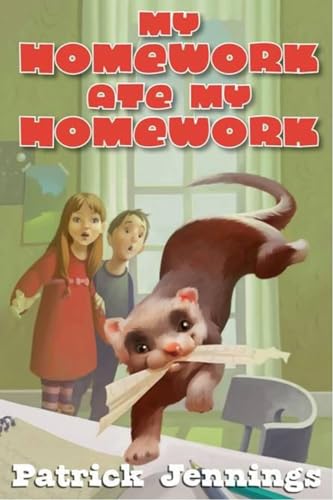 I would like to draw your attention to one of the newest chapter books for Grades 3-6, Patrick Jennings' My Homework Ate My Homework.
 The main character, Zaritza, was, shall we say, in need of a little extra credit for her math grade. That's the reason she agreed to take care of Bandito, the class pet--even though she did not really like ferrets much, and she had other things on her mind, like getting a good part in the school play.
As you might have guessed from looking at the cover picture, this is a funny book, and things did not go exactly as planned.
In fact, the story began at the ending, when Zaritza told her teacher that Bandito escaped. I have to admit, the explanation for that dialog was not what I expected.
Check it out! You'll enjoy it.
Wednesday, September 4, 2013
Learning | Charlie Goes to School
SSJCPL bloggers have been posting about the back to school theme quite a bit lately. I hope you can indulge me while I write about yet another book on the topic of school.
Most of our back-to-school posts are assuming that children are learning in a school building that is designed only for that purpose. They leave their home in the morning, have their lessons in the school building with children from other families, and return home at the end of the day. Of course, there are plenty of families whose children are homeschooled, in the same building where they live, like the characters in Charlie Goes to School.
Most of our back-to-school posts are assuming that children are learning in a school building that is designed only for that purpose. They leave their home in the morning, have their lessons in the school building with children from other families, and return home at the end of the day. Of course, there are plenty of families whose children are homeschooled, in the same building where they live, like the characters in Charlie Goes to School.
![[Cover]](http://www.syndetics.com/index.aspx?isbn=9780062219206/LC.GIF&client=209-937-8362&type=xw12&upc=&oclc=813929605&) Charlie Goes to School is a picture book by Ree Drummond, with beautiful illustrations by Diane de Groat. You may already be familiar with the main character from Ree Drummond's I Can Read Book, Charlie the Ranch Dog: Where's the Bacon? Charlie is based on Ree Drummond's real-life basset hound.
Charlie Goes to School is a picture book by Ree Drummond, with beautiful illustrations by Diane de Groat. You may already be familiar with the main character from Ree Drummond's I Can Read Book, Charlie the Ranch Dog: Where's the Bacon? Charlie is based on Ree Drummond's real-life basset hound.
Charlie sees his human family learning at home on their ranch, and he starts thinking about all of the things he knows. It isn't very long before he decides to open his own school. His students are the other animals on the farm--and he encounters a few classroom management issues. (Can you imagine teaching a kitten and a puppy to read and count? It wouldn't be easy.)
Homeschooling families will especially enjoy this book. Children who like animals will like it, too. It reminds me of a story about one of my sons' favorite preschool teachers, Miss Barbara. Miss Barbara's mother told me that she used to pretend she was a teacher when she was a little girl; she put all of her dolls and stuffed animals in chairs, and wrote assignments on the blackboard. I can imagine this book inspiring a child or two to teach their pets, friends, siblings or toys how to say the alphabet or count.
The target audience for Charlie Goes to School ranges from preschoolers to third grade.
P.S. Here's the link for Ree Drummond's The Pioneer Woman Cooks : Food from My Frontier, which Rena mentioned in her comment below.
The target audience for Charlie Goes to School ranges from preschoolers to third grade.
P.S. Here's the link for Ree Drummond's The Pioneer Woman Cooks : Food from My Frontier, which Rena mentioned in her comment below.
Wednesday, August 28, 2013
Learning | Weird Writing Tips from Dan Gutman

If you are around books for school age children much, you have probably seen Dan Gutman's popular series, My Weird School. If you have seen them, you have probably laughed at some of the silly titles in the series, like Miss Mary is Scary! or Mr. Granite is From Another Planet!
I am pleased to say that Mr. Gutman has a new nonfiction book out, called My Weird Writing Tips. What can I say about a book whose introduction has the headline, "Don't be a dumbhead?" That's a pretty good tip right there. The characters from the My Weird School series are used to teach writing to kids, in cartoons to show which word to use when. There are even quotes famous people like Henry David Thoreau, Mark Twain, and P.D. James--all of whom know a thing or two about writing.
I am pleased to say that Mr. Gutman has a new nonfiction book out, called My Weird Writing Tips. What can I say about a book whose introduction has the headline, "Don't be a dumbhead?" That's a pretty good tip right there. The characters from the My Weird School series are used to teach writing to kids, in cartoons to show which word to use when. There are even quotes famous people like Henry David Thoreau, Mark Twain, and P.D. James--all of whom know a thing or two about writing.
I like his discussions of where to get ideas for topics, the importance of taking the time to write something all over again the right way, and to keep studying the best writers.
The cover of the book is says it's for ages 8 to 12, but I always look at such labels as guidelines. I think I picked up a tip or two for my own grownup self here.
Wednesday, August 21, 2013
Learning | Collective Nouns
I live near the water, so I often see flocks of geese in my neighborhood. Flock is an example of a collective noun, which is a noun used to refer to a whole group of things. Think of a herd of cattle, or a pack of wolves. One of my favorite collective nouns is an embarrassment of riches. I think that's especially poetic.
SSJCPL has a veritable plethora of books on English language collective nouns. Some of these books have been around quite a while, but I would like to draw your attention to a new one. It's a children's book called A Crackle of Crickets: A Compilation of Insect Collective Nouns.
 |
| Illustration from A Crackle of Crickets. Can you guess which collective noun this picture illustrates? Find the answer at the end of this post. |
As I pondered the whole idea of collective nouns, I found myself asking a bunch of questions: If the plural of goose is geese, why isn't the plural of moose meese? I have always heard that moose is the plural for moose. Why isn't it meese? Or mooses? And what would Bullwinkle's Mr. Know-It-All think about this topic?
 | ||
| Bullwinkle. Photo courtesy of gamerscoreblog's photostream on Flickr.com. Some rights reserved. |
Well, you know me; I couldn't resist a chance to look up another word in the dictionary. In my search for an answer, I discovered that moose is the North American term for elk. This animal is the largest member of the deer family. The native Abnaki people of Maine and Southern Quebec had a term, mos, for this beast; that is believed to be the origin of the English word.
I learned that moose is the most common plural of moose these days, but meese and mooses are acceptable older forms. I remain skeptical about that. I don't think I could get away with playing meese in a Scrabble game. Plural moose are moose, just as plural deer are deer (not deers.) It has nothing to do with the goose/geese thing.
 |
| Moose family, Berlin NH; courtesy northeast_naturalist's photostream on Flickr.com. Some rights reserved. The Latin name for these creatures is Alces alces americana. |
I learned that moose is the most common plural of moose these days, but meese and mooses are acceptable older forms. I remain skeptical about that. I don't think I could get away with playing meese in a Scrabble game. Plural moose are moose, just as plural deer are deer (not deers.) It has nothing to do with the goose/geese thing.
But if the plural of mouse is mice, what would the plural of mousse be? If only Mr. Know-It-All were here....
 |
| Moose mousse. Photo courtesy of Fraser Lewry's photostream on Flickr.com. Some rights reserved. |
Answer to the question about the top picture: a culture of bacteria.
Subscribe to:
Posts (Atom)