Showing posts with label mysteries. Show all posts

Saturday, January 24, 2015

Learning | Montmartre

Montmarte's been on my mind lately, because of a few books I've been reading. You know Montmarte, the section of Paris with the Can Can dancers, artists, and Bohemian lifestyle at the end of the nineteenth century? The name conjures up visions of the Moulin Rouge, and Henri de Toulouse-Lautrec.

Toulouse-Lautrec. Image from page 9 of "Le peintre-graveur illustré : (xix et xx siècles)" (1906)
from the Internet Archive Book Images' photostream on  Flickr.com.
No known copyright restrictions.
The name Montmartre means "Mountain of the Martyr," referring to St. Denis, who is said to have been beheaded on this hill in 250 A.D. It's interesting to note that the older, Roman name for this place is Mons Martis (Mount of Mars.) Here's a YouTube video, with the English pronunciation of the word:


If you would prefer to say a French place name as the French do, you can visit Forvo.com to listen to French speakers speaking the word.

There's an amusing quote about pronunciation of Montmartre in C. Alan Bradley's latest mystery, As Chimney Sweepers Come to Dust: A Flavia de Luce Novel. Flavia described a facial characteristic that "can come only from speaking French from the cradle." She deduces which faculty member at her new school is the French teacher because of this trait; she supports her conclusion in a discussion of a woman in Bishop's Lacey, England. "She was from Montmartre, pronounced through the nose." 

Flavia says so many pithy things, that I probably would not have noticed the Montmartre reference, if I had not just finished reading a more macabre mystery. The Devil in Montmartre: a mystery in fin-de-siècle Paris by Gary Inbinder is a sometimes gruesome historical mystery. Toulouse-Lautrec is one of several suspects, which include Jack the Ripper and some international visitors. The characters include artists, art dealers/agents, writers, doctors, photographers, dancers, prostitutes, ragpickers and acrobats, to name a few categories.  The story takes place near the end of the Paris Exposition universelle de 1889. That was the World's Fair; the Eiffel Tower was created for the event. A young detective on the case tries to get his superiors to accept the use of fingerprints as evidence; he has read about them.  This case provides an opportunity to experiment with techniques for collecting fingerprints, and interpreting the results logically.  Look out for plot twists!

Since I'm on a Montmartre kick right now, I looked around for other historical mysteries related to the topic.  

Murder in Montmartre: an Aimee Leduc Investigation, by Cara Black is not available from SSJCPL's system, but I just requested this book through Link+. It's good to know there's another Aimee Leduc mystery that I have not yet read! I like this fast-paced series, which takes place in modern Paris. Aimee Leduc is a young private investigator with a computer-savvy partner. Because Paris has been around for so long, investigations often touch on objects or subjects which have a link to the past.

Wednesday, September 17, 2014

Learning | Scree

If you have read any of Elizabeth Peters' Amelia Peabody Mysteries, you have probably encountered the word scree, meaning landslip. (If you have not read them, the word comes up frequently, since the main characters are archaeologists who often excavate in Egypt. There's scree all over the place!)

This comes from an Old English word, related to the Swedish and Danish skred, meaning to slide or glide. 

It also means a mass of detritus, forming a precipitous, stony slope upon a mountain-side; also, the material composing such a slope.


Screefrom Carlos Baquero's photostream on Flickr.com. 
Some rights reserved.

I turned to the Oxford English Dictionary for the definition, because I thought I had found another use of the word in the book I'm currently reading. 

It's an historical novel by Nancy E. Turner, titled My Name is Resolute.  


It's the story of a tenacious young girl who is captured from her aristocratic Jamaican home, then sold several times as a slave.  

She carries valuable family treasures, such as coins and jewelry, sewn into pockets on her petticoat. 

(She also settles in colonial Lexington, Massachusetts, in the years leading up to the American Revolution. But I'm getting ahead of myself.) 


Here's the quote from page 197, which employs the word scree:

"How shall I make myself into a woman? As I made an apron, as I made my own thread and turned it into a plaited cloth, hid my scree within, and then was abandoned by my only kin?"

I puzzled over this for a while.  Was this an editing error? Did the author really mean to use the word scree, or a similar word, screed? 

Screed is a word with multiple meanings;  it is probably derived from the word shred. Turner had already described that petticoat as tattered and patched up. I don't think she meant screed in the above passage.  

Scree lobelia in fruit, from John Sullivan's photostream on Flickr.com.
Some rights reserved.
The original meaning of scree might be used here as a part of a metaphor, describing the changes in Resolute's circumstances as a series of slides and slips down a mountain.


The above photo of a scree lobelia plant bearing fruit amongst rocks on the side of a mountain reminds me of the main character, Resolute Talbot.  She is a strong-willed child, who grows into a determined, productive woman. I won't spoil the story for you with specific details, but she plays a very important role in the American Revolution.

Thursday, July 17, 2014

Book Bucket List | The Heiresses

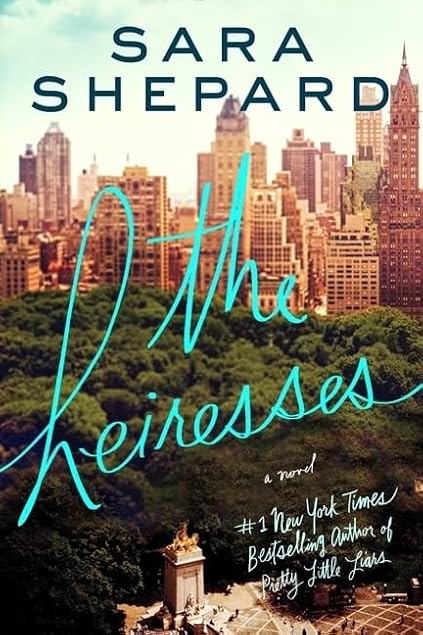
I'm a very impatient person.  I'm well aware of this fault and have to remind myself to be patient all the time.  This even applies to the books I read.  I've never enjoyed mysteries very  much because I just want the book to get to the point already!  My impatience is the reason why I've never read very many mysteries, except maybe for school or a book club.  However, we recently got a huge shipment of new books and one book in particular caught my eye.  It was The Heiresses by Sara Shepard, and it happened to be a mystery.

I knew Sara Shepard was a popular author, she penned the very popular series Pretty Little Liar which is now a TV show.  So after reading the jacket, I decided to give it a chance.  The Saybrook family seems to have it all.  They own one of the most successful jewelry stores around (think Tiffany's) and are one of the most envied families in Manhattan.  However, their family is cursed with accidents and tragedy.  After one of their own is found dead (again!) they band together to try to figure out who is attacking their family.

This was a fun read for me.  The characters live these unbelievable lives, so it was fun to escape into that for a little while.  And honestly, I liked reading about their clothes.  Though it was still a mystery, and I wanted more clues and the plot to move forward a little more than it was, but I still enjoyed it.  It's a very fluffy mystery, not too dark and grisly.

Wednesday, June 4, 2014

Learning | Science! It's what's for Summer Reading

Science is the word this summer! We have science-themed programs for adults, teens, and kids. The adult theme is "Literary Elements;" for teens, it is "Spark a Reaction," and, of course, for children, it is "Fizz, Boom, Read!"


This week, let's talk about "Literary Elements," the theme for adults. Most of us realize that the library has books full of scientific facts in the non-fiction and reference areas of the collection. But we have some fiction that's scientific, too.


Fiction


I cannot think of a better fiction series to link to the "Literary Elements" theme than Camille Minichino's Periodic Table Mystery series.  The main character, Gloria Lamerino, is a retired physicist, who has a second career as a science consultant for the police. (She also happens to be in love with a police detective.) She has an amazing scientific mind and her share of foibles, and interesting friends; what's not to like?

Each book in the Periodic Table series focuses on a particular element, which is central to the solution (no pun intended) to the mystery, for example, "The Nitrogen Murder." These are fun reads, and not too gruesome. Think of them as cozy science mysteries.  

Fun fact: Camille Minichino visited the Tracy Branch Library some years back. There was a library program about mystery writers, and she was on the panel.

Science Fiction

There is another fiction genre that dovetails nicely with this year's theme: science fiction.This genre is chock full of interesting stories and talented writers.  Science fiction stories are based on imagined and/or future worlds. They often feature scientific or technological advances. Some of these worlds portray dystopian societies, for example, Ray Bradbury's classic, Fahrenheit 451, in which books are burned. (Eek!)


Not fiction, but a really good story

Biographies are accounts of real people's lives. I find that reading a biography can be as engrossing as a fictional story.  

For example, read this book by Berkeley neurobiologist Sybil Lockhart: Mother in the middle: a biologist's story of caring for parent and child

Many of us have had the experience of caring for an elderly parent with dementia, and caring for our own children at the same time.  Lockhart's story is especially interesting, because her expertise in neurobiology allows her to alternatively marvel and cringe at the effects of the disease progression on her mother--and at the developmental biological effects occurring in her growing daughters. 

Wednesday, October 30, 2013

Learning | Yes, Learning. That's What I'm Doing This Week!


This will be a short blog post. I'm attending the Internet Librarian 2013 conference in Monterey this week.  It's been difficult finding time to compose a post--and to make sure I am in a spot where wi-fi is functioning, when I try to edit it. And then there's the brain-brimming-over issue; I attend at least 5 informative sessions each day. 

For instance, on Tuesday night, I saw a wonderful presentation on metadata. Metadata is a word that means "data about data." Metadata helps us find the data we are looking for more easily--think in terms of the author, title and publication date of a book. If librarians didn't spend time thinking about the best ways to organize things, you might find really silly arrangements for books, perhaps by color, height, or number of pages.


Even at dinner, I've been joining other conference attendees for Dine-Arounds. We meet for dinner at a specified place, and converse about specific topics. One night, we talked about E-Books at a Greek restaurant. Another night, we talked about Creating New Services, while we ate at an Indian restaurant. The sampler plate I ordered there included some butter chicken. That reminded me of a mystery series by Tarquin Hall, about a detective named Vish Puri. The stories are set in India. One book in the series is called The Case of the Deadly Butter Chicken.  I learned two things about butter chicken at that restaurant: it tastes really good, and it is not generally deadly.

Wednesday, October 23, 2013

Learning | Matthew Shardlake Mysteries

Historical mysteries are so much fun. The history nerd in me loves learning details of life in days of yore, or comparing what I already know about a certain time period with the author's portrayal. The best authors of historical fiction (whether they write in the mystery genre or not) write with a certain authoritative quality that only comes from extensive research and study of a subject.

For example, take a look at the author of the Matthew Shardlake series. C. J. Sansom not only earned both a B. A. and a PhD in history--he became a solicitor after all of that. His sleuth, Matthew Shardlake, is a solicitor in Tudor England. Sansom's realistic depiction of daily life--and legal conflicts--during the reign of Henry VIII make these mysteries hard to put down.  

The following is the first paragraph from the third book in the Shardlake series, Sovereign:


"It was dark under the trees, only a little moonlight penetrating the half-bare branches. The ground was thick with fallen leaves; the horses' hooves made little sound and it was hard to tell whether we were still on the road. A wretched track, Barak had called it earlier, grumbling yet again about the wildness of the barbarian land I had brought him to. I had not replied for I was bone-tired, my poor back sore and my legs in their heavy riding boots as stiff as boards. I was worried, too, for the strange mission that now lay close ahead was weighing on my mind. I lifted a hand from the reins and felt in my coat pocket for the Archbishop's seal, fingering it like a talisman and remembering Cranmer's promise: 'This will be safe enough,there will be no danger.'" 

Shardlake has a hunchback, or crooked spine, which causes him physical pain, but also engenders ill will from people who believe that deformity is a sign of evil.  He is an intelligent,  erudite, perceptive gentleman.  It's interesting to watch his character change as the series progresses; he is much more naive and idealistic in the first book, Dissolution. He becomes increasingly wary of others' motives as he grows older.


Tuesday, October 16, 2012

4 Kids | Spies, Detectives, and Plot-Maker

Hello kids! I love books that let your imagination run wild....that take you to faraway places....that introduce you to inspiring people.
 
But I also love books that let you have a little fun....like these! Play I Spy, pay attention to clues to solve a mystery, or choose how the plot will develop.
 
 
In Joan Steiner's Look-Alikes, the reader is invited to find over 1,000 look-alikes. The pictures in this book are of everyday objects used in unexpected ways. Play a little "I Spy" with a friend. "I spy some broccoli...." "I spy a pretzel...." Have some fun!


For you older readers who like to solve mysteries, try Great Quicksolve Whodunit Puzzles: Mini-Mysteries for You to Solve by Jim Sukach. Each chapter is a chance for you to help Dr. J.L. Quicksolve solve a crime. Pay attention to the clues and listen to the suspects. Be on the lookout for liars, tricksters and unlikely alibis. If you think you've solved a crime, check in the back of the book for the solution!


One of my all-time favorites is Encyclopedia Brown, Boy Detective by Donald Sobol. Encyclopedia's Dad is the chief of police who often turns to his young son for help in solving crimes. Like the Quicksolve books, the solutions are at the back of the book. But don't cheat! Try to solve each chapter first. And if you like this one as much as I do, you'll find a whole bunch of other Encyclopedia Brown books at a library near you!


My last book for you today is actually a series of books: Choose Your Own Adventure! In the book Blood on the Handle, Uncle Morgan vanishes, leaving behind a single clue: a jewelled dagger stabbed through the carpet of his study, coated in dripping blood. You, the reader, get to decide in what direction the story will go! These are so much fun! Seriously! Check them out! You'll find them at a library near you where the series books are shelved.


And if you can't find one of these books at your nearest library, ask staff to help you place a request!