How many of you have enjoyed flipping through Roget's Thesaurus, looking for random groups of synonyms? I think most of us used it for schoolwork, when looking for the right word to describe something, or trying not to use the same word over and over again in an essay. But I loved picking up the book and learning more about words and their relationships to other words.
A 2015 Caldecott Honor book presents a similar pleasure, in the form of a children's picture book about the life of Peter Mark Roget.
The Right Word: Roget and His Thesaurus by Jen Bryant and Melissa Sweet is a visual treasure trove of lists, synonyms, and facts. It tells the tale of a shy young boy who loved to make lists. Some of those lists turned into a book that most of us remember from our school days, Roget's Thesaurus.
The The Right Word's pages are illustrated with watercolor, collage, and mixed media. They effectively draw the reader in, to explore, discover, and become inspired. This is clearly a book that holds interest, even after repeated readings. I saw one review that compared reading The Right Word to looking through an old curio cabinet!
The publisher of this book, Eerdmans Books for Young Readers, has a delightful video trailer for The Right Word on its YouTube Channel.

Showing posts with label picture books. Show all posts
Showing posts with label picture books. Show all posts
Wednesday, February 25, 2015

Wednesday, September 4, 2013
Learning | Charlie Goes to School
SSJCPL bloggers have been posting about the back to school theme quite a bit lately. I hope you can indulge me while I write about yet another book on the topic of school.
Most of our back-to-school posts are assuming that children are learning in a school building that is designed only for that purpose. They leave their home in the morning, have their lessons in the school building with children from other families, and return home at the end of the day. Of course, there are plenty of families whose children are homeschooled, in the same building where they live, like the characters in Charlie Goes to School.
Most of our back-to-school posts are assuming that children are learning in a school building that is designed only for that purpose. They leave their home in the morning, have their lessons in the school building with children from other families, and return home at the end of the day. Of course, there are plenty of families whose children are homeschooled, in the same building where they live, like the characters in Charlie Goes to School.
![[Cover]](http://www.syndetics.com/index.aspx?isbn=9780062219206/LC.GIF&client=209-937-8362&type=xw12&upc=&oclc=813929605&) Charlie Goes to School is a picture book by Ree Drummond, with beautiful illustrations by Diane de Groat. You may already be familiar with the main character from Ree Drummond's I Can Read Book, Charlie the Ranch Dog: Where's the Bacon? Charlie is based on Ree Drummond's real-life basset hound.
Charlie Goes to School is a picture book by Ree Drummond, with beautiful illustrations by Diane de Groat. You may already be familiar with the main character from Ree Drummond's I Can Read Book, Charlie the Ranch Dog: Where's the Bacon? Charlie is based on Ree Drummond's real-life basset hound.
Charlie sees his human family learning at home on their ranch, and he starts thinking about all of the things he knows. It isn't very long before he decides to open his own school. His students are the other animals on the farm--and he encounters a few classroom management issues. (Can you imagine teaching a kitten and a puppy to read and count? It wouldn't be easy.)
Homeschooling families will especially enjoy this book. Children who like animals will like it, too. It reminds me of a story about one of my sons' favorite preschool teachers, Miss Barbara. Miss Barbara's mother told me that she used to pretend she was a teacher when she was a little girl; she put all of her dolls and stuffed animals in chairs, and wrote assignments on the blackboard. I can imagine this book inspiring a child or two to teach their pets, friends, siblings or toys how to say the alphabet or count.
The target audience for Charlie Goes to School ranges from preschoolers to third grade.
P.S. Here's the link for Ree Drummond's The Pioneer Woman Cooks : Food from My Frontier, which Rena mentioned in her comment below.
The target audience for Charlie Goes to School ranges from preschoolers to third grade.
P.S. Here's the link for Ree Drummond's The Pioneer Woman Cooks : Food from My Frontier, which Rena mentioned in her comment below.
Wednesday, August 14, 2013
Learning | Learning From Each Other
Ever since Suzy pointed out that it's back to school time, I've noticed people getting ready for school. There are sales in the stores for school supplies, and library customers have been talking about school starting for weeks. Most students are already back at school, or will be in school very soon. I just can't deny it; summer is ending.
There's a new picture book that arrived just in time for the new school year. Al Yankovic's My New Teacher and Me is a story told in rhymes. Mr. Yankovic (who usually goes by the name "Weird Al") seems to have been influenced by Dr. Seuss for this project. The "me" in the book title is Little Billy; on the first day of the school year, he tells so many tall tales that his new teacher, Mr. Booth, is skeptical. In fact, Mr. Booth uses the words "highly unlikely" in response to the first story Little Billy tells. But something happens near the end of the book that makes him wonder if he's wrong about that.
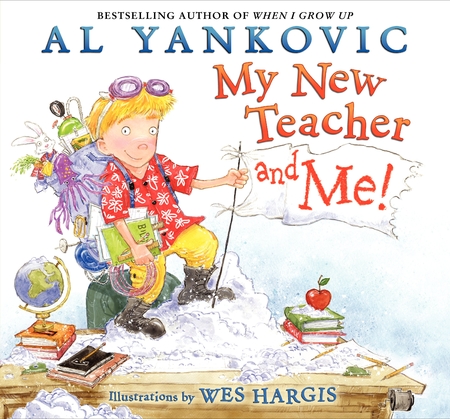
This is a book that will make you giggle, but it will also make you remember that, just as students learn from teachers, teachers learn from students.
Wednesday, March 13, 2013
Learning | Rebuses
Rebuses are representations of words or phrases, using pictures, letters and numbers. For instance, the number and letter combination of B4 stands for the word "before." I see people using rebuses frequently when they're texting or chatting on social networks; for example, "C U later" stands for "see you later."
SSJCPL's rebus books tend to be for an audience of young children. This makes sense, because rebuses are a fun tool to use to write words--and they are easy for emerging readers to understand. You don't need to know how to spell, in order to understand a picture. I suspect rebuses are part of the appeal of the immensely popular Dora the Explorer books.
There are plenty of rebus picture books:

This is an unusual picture book. The pages are filled with pairs of black and white photographs that act as rebuses, suggesting a pun.
Can you guess the answer to the picture here? Hint: The answer is the name of some sweet treats. The solution to this puniddle is at the bottom of the picture, printed upside down. Click on the picture, to enlarge the image.
Can you guess the answer to the picture here? Hint: The answer is the name of some sweet treats. The solution to this puniddle is at the bottom of the picture, printed upside down. Click on the picture, to enlarge the image.
 Judy Sierra's We Love Our School!: a Read-Together Rebus Story has rhyming rebuses on the left page, illustrated by a brightly colored picture on the right page. The rebus symbols on the left page are easily recognized in the big illustration to the right.

If you want a complicated picture book, try Shirley Neitzel's cumulative rebus stories.

For example, The House I'll Build for the Wrens has a narrator who adds another phrase to her recitation each time she plans another step in the birdhouse construction process.
Jean Marzollo's I Love You: A Rebus Poem is a very simple picture book with few words. It's like a love poem with pictures. It ends with a rebus version of "And I love you."


We have some easy readers with rebuses. Easy readers are books for beginning readers with the call number "JEZ." Did you notice that this call number has a rebus? "EZ" stands for "easy."
A Friend for Noodles is a good example of an easy reader rebus book. We follow the story of a little dog who searches for a lost teddy bear, and makes a friend in the process.
Somehow looking at rebuses gives me an itch to try it myself, especially when I look at the puniddles. I hope you're inspired to try your hand at it, too.
A Friend for Noodles is a good example of an easy reader rebus book. We follow the story of a little dog who searches for a lost teddy bear, and makes a friend in the process.
Somehow looking at rebuses gives me an itch to try it myself, especially when I look at the puniddles. I hope you're inspired to try your hand at it, too.
Subscribe to:
Posts (Atom)