Showing posts with label fiction. Show all posts

Friday, August 14, 2015

Award-Winning Reads | To Kill a Mockingbird

Hello there readers!

I'll be honest. It's been some time since I posted a blog here on Award-Winning Reads. It's been so long that I almost forgot how to log into Blogger! But I hope you all will stick around with me as I now post twice a month about beloved award-winning books.

This week I'm sharing one of my all-time favorite modern American classics: To Kill a Mockingbird by Harper Lee. This literary gem won the Pulitzer Prize for Fiction in 1961. The Pulitzer Prize is awarded by Columbia University for achievements in newspaper and online journalism, literature, and musical composition in the U.S. The similarly-titled 1962 film based on the book is also a critically-acclaimed prize-winner, having earned three Academy Awards.
Pulitzer Prize. Claiming fair use, this photo is being used for informational purposes only, to illustrate what the award looks like.
Shoot all the bluejays you want, if you can hit 'em, but remember it's a sin to kill a mockingbird. 
To Kill a Mockingbird is a coming-of-age story, or bildungsroman, told from the viewpoint of young Jean Louise Finch, better known as Scout. Scout is a headstrong, curious girl who witnesses the fictional Alabama community's uproar as her father, Atticus Finch, legally defends an innocent black man accused of raping a white woman. Scout's experiences move her to question the deeply-held racial prejudices of her neighbors.

I remember being required to read the book and watch the movie in Mr. Thompson's eighth-grade class at Hamilton Middle School. As a young girl, I appreciated that Scout was a strong female character. She wasn't afraid to voice her thoughts and opinions while she was yet still trying to understand the scope of what was going on around her.
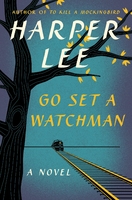
Until recently, this was Lee's only published novel. However, a month ago, on July 14th, Go Set a Watchman, a follow-up story, was released. It features many of the same characters from its predecessor twenty years later. I'll be listening to the audiobook. Reese Witherspoon is performing it!
 
Not by coincidence, the title of one of my most cherished cocktails recipe books is a play on words of Lee's first story. Tequila Mockingbird: Cocktails with a Literary Twist serves up literary libations such as "The Joy Luck Club Soda" and "Gin Eyre" as well as a few tasty treats like "Alice's Adventures in Wonder Bread" and "Prawn Quixote." It even offers non-alcoholic beverages that are puns of juvenile book titles such as "Pear the Wild Things Are" and "The Blizzard of Oz."

Now that I think about it, I just might celebrate Lee's sophomore novel by making myself a "Tequila Mockingbird" (with more tequila and less hot sauce than the recipe requires), before listening to Reese's sweet southern drawl.

Next time I'll discuss the work of another female author - the first female to win the Pulitzer Prize for Fiction. There's always more Fan Favorite Fiction from Females to love! 

Until then, have a good reading! (And if you need a "Rum of One's Own," to get you started off right, I promise, I won't tell! *wink, wink*)
Raquelle

Friday, April 10, 2015

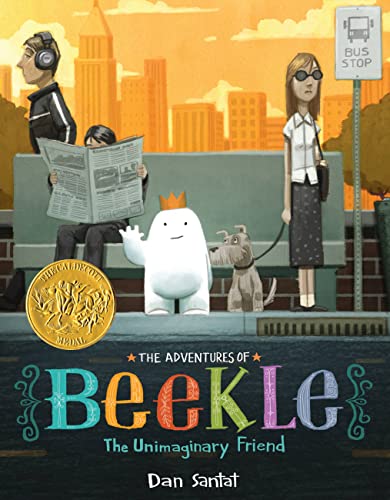
Award-Winning Reads | The Adventures of Beekle


Sometimes the best friends lie just beyond our imagination.

Did you have an imaginary friend when you were young? Many children do. The winner of the week references this common childhood experience; however, the imaginary friend in this story does the unimaginable

In The Adventures of Beekle: The Unimaginary Friend, follow Beekle as he ventures from a faraway island to the real world to finally meet his match - a special friend living in the city. It is a sweet tale about friendship and imagination. 

My friend and coworker Candace described it as a sort of reverse telling of another award winner, the 1964 Caldecott medalist, Where the Wild Things Are. Do you notice the crown and the white playsuit in both books?

The Adventures of Beekle is written and illustrated by Dan Santat. You might recognize his work from the Ricky Ricotta's Mighty Robot books. Santat won this year's prestigious Caldecott Medal! 

According to the American Library Association (ALA), the organization who designates these medals and honors, the Caldecott Medal was named in honor of nineteenth-century English illustrator Randolph Caldecott. The medal is awarded annually to "the artist of the most distinguished American picture book for children."
This is a logo for the Caldecott Medal. Claiming fair use, this photo is being used for informational purposes only, to illustrate what the award looks like.

Head to your local library and pick up this award-winning book that will surely delight readers of all ages!

Until next time, have a good reading!
Raquelle

Friday, April 3, 2015

Award-Winning Reads | A Monster Calls

The monster showed up after midnight. As they do. But it isn't the monster Conor's been expecting. He's been expecting the one from his nightmare, the nightmare he's had every night since his mother started her treatments, the one with the darkness and the wind and the screaming . . .   

This monster, though, is something different. Something ancient, something wild. And it wants the most dangerous thing of all from Conor.   

It wants the truth.
Image result for a monster calls patrick ness
Hello Everyone,

I've been in a bit of a somber, serious mood lately. (And no, that's not me reflecting and ruminating in the image to the right. Trust me, when I'm thinking deeply I look a lot scarier than that)! Unfortunately, there have been a couple of special people who were connected with the Tracy Library as well as people who I associated with in my congregation who passed away. I couldn't help but recall this literary treasure, which also reminded me how painful suffering loss can be.

The critically-acclaimed award winner of the week that I'm highlighting originates from across the pond. This book won, not only one, but two medals: the Carnegie and Greenaway Medals. According to the Chartered Institute of Library and Information Professionals (CILIP), the organization which confers these medals, the Carnegie and Kate Greenaway Medals are the United Kingdom's oldest and most prestigious children's book awards. Talk about a double honor!

The medals are awarded by children's librarians to books for children and young people. The Carnegie Medal is awarded for an outstanding book and The Kate Greenaway Medal is awarded for an outstanding book in terms of illustration. Since this title won both, you can expect an excellently executed story line with equally impressive illustrations.

And the 2012 Carnegie and Greenaway Medals go to . . .

(drum roll, please)


A Monster Calls! It is written by Patrick Ness, inspired by an idea from Siobhan Dowd, and illustrated by Jim Kay.

(I know the reveal isn't as dramatic since it's included in the title of this post, but please just try to act a little surprised).


I first read this hauntingly beautiful novel as an ebook on OverDrive and was immediately drawn to Conor, a thirteen-year-old boy who was primarily cared for by his mother. Conor struggles with his feelings while watching her battle a life-threatening illness. Suddenly an unnamed monster (why are the scariest monsters usually unnamed?) begins to regularly call on him at night. Who is this titular monster? Is it real or imagined? Friend or foe? And what could it possibly want with Conor? (Hint: it's in the opening quote). 


As the story develops and builds tension, so does Conor. His pent-up frustration and helplessness in a situation far beyond his control ultimately reaches its peak and the truth he discovers about himself leads to his much-anticipated catharsis. The black and white illustrations accentuate the dark, fantastical undertones of the story. If you want to try a deeply moving read, check out this book. 

Let me leave you a line from the novel.        

Stories are wild creatures. Who knows what havoc they might wreak?
Next week, find out about two friends - one human and one unimaginary (yes,  unimaginary *ooh*)!

Until next time, have a good reading!
Raquelle

Wednesday, June 18, 2014

Learning | How Is that Word Pronounced?

Recently, I participated in a conversation about words we read. Sometimes we understand from the context, but imagine the pronunciation differently from the accepted norm.

For example, a friend said he always understood what awry meant, whenever he came across it in a book.  (The word means something is not working correctly or happening in the expected way; another meaning is to be in a position that is not straight or neat.) It is not a commonly spoken word, so he always guessed that it rhymed with story. 

I looked up the etymology of awry. It has origins in Middle English; the first syllable, comes from the root a-, which means on. The second syllable, wry, is an adjective that means twisted or bent. It is pronounced \É™-ˈrÄ«\ (uh-RYE.)

A relative of mine guessed incorrectly about poignant  and Des Moines--perhaps because she had studied French for years, yet never heard these words with French origins pronounced out loud. 

Since she doubted Americans would say these words like Parisians would, she overcorrected for the use of these words in English, and therefore pronounced the g in poignant and the s in Des Moines (actually, both of them.)

Several of my co-workers were puzzled by the word acme as children. Many of us had the childhood experience of watching a certain cartoon coyote, who was always ordering kits from a company called Acme, which seemed to make an Acme version of everything, even things we had never imagined. I never had a problem with the word. I must have heard my older siblings pronouncing it correctly, which makes the word rhyme with acne. A few people seem to read that letter c with a soft s sound, but it needs the hard k sound.

Tiny Martini: Martini Mello Smello Scratch and Smell Sticker, from Enokson's photostream on Flickr.com. Some rights reserved.


The daughter of a co-worker thought the dry cleaning process, martinizing, was pronounced "martini zing."  I like her way of saying it. It sounds like the feeling a person might get after drinking a martini.

It was chemist Henry Martin who pioneered a speedier process that was deemed safe to use in a dry cleaning facility. 

Before the martinizing process came along, dry cleaners had to send clothing out to facilities in sparsely populated areas, and customers had to wait a long time for them to come back.  

Anyway, since the word for the process was derived from Mr. Martin's last name, it is simply pronounced "Martin" plus "-izing," in the same way we say sanitizing or humanizing.


One Hour Martinizing, from Thomas Hawk's photostream on Flickr.com. Some rights reserved.


If the word martinizing sparks your imagination, you might consider reading some cozy, clean stories. SSJCPL has a surprisingly long list of fiction books related to the dry cleaning industry. 

Send me your confusing words. Send me your friends' confusing words! I'll do my best to explain them.

Wednesday, May 14, 2014

Learning | Speakeasies

Here's a sentence I never thought I would type: I recently visited a speakeasy in San Francisco, and it was a learning experience!

Here are a few facts I learned in connection to my visit:


Cocktail,
from Francisco Meirino's photostream on Flickr.com
Some rights reserved.
The term speakeasy reflected the need for secrecy, when serving liquor that was prohibited by the Volstead Act (also known as the Eighteenth Amendment to the United States Constitution.) Customers were asked to "speak easy," to avoid drawing attention to the business. You may have seen movies or cartoons showing people knocking on a door to give a password ("Al sent me") to enter. Speakeasies were also known as blind pigs, or blind tigers. As I poked around for information after my visit, I learned that blind pig probably got its name in the first half of the 19th century, long before the Prohibition Era. Illegal drinking establishments, selling poor-quality, unregulated liquor sometimes skirted the law by charging money to see an interesting pig...and giving a free shot of gin to those who paid admission.

That brings me to the subject of bathtub gin. I have heard that term ever since I was a small child, and thought it meant people used a bathtub to make homemade liquor. (Yuck!!!)  But that's not quite true. People found many ways to make liquor, during the period when they could not buy it, and they did make gin; they made gin in a container that was too large to be filled with water from the sink--it had to be set in the bathtub, in order to add water from the bathtub tap.

Cocktails, or mixed drinks containing alcohol and two or more ingredients, became popular during the Prohibition era. Think about it--in those days, it was much harder to obtain brand-name, quality liquor, so complicated recipes were invented to cover up bad flavors. Some have also observed that cocktails would be more practical in a speakeasy, because they are easier to consume quickly, before running out the back door to escape a raid. 


The term Old-Fashioned was invented to distinguish a simpler, older mixed drink from cocktails, which were considered to be complex.  Old-Fashioneds are made by muddling sugar with bitters, then adding alcohol, and finally a twist of citrus.  (That sounds fairly complicated to me, but, then, I'm not much of a drinker.)

For your vicarious, and totally legal, enjoyment, I have prepared a list of fiction books about Prohibition for adult readers. No pigs required!

If you are interested in historical facts and the social ramifications of the Eighteenth Amendment and its repeal, I have compiled a short list of


Wednesday, February 12, 2014

Learning | Doldrums

If we are to believe the prognostication of a certain groundhog in Pennsylvania, winter will be here for another six weeks or so. Many people are sick and tired of winter, especially back East, where polar vortexes seem to send storm after storm. My best friend, Roberta, who lives in New Jersey, recently proclaimed, "Enough, already!"

Doldrums of Spring, from jonasflanken's photostream
on Flickr.com. Some rights reserved.
We have finally started to get rain here in the Central Valley. We know we need the rain. Most people I talk to are really glad to see it. But if it continues, I wonder how long it will be until I hear library customers wishing for spring and sunshine.

There's a word for the melancholy feeling we get, when the weather has been gloomy for too long: doldrums.  Doldrums first appeared in written form in the late 18th century.  Its origins are murky; it seems to have come from the past participle of the Old English verb, dullen, which is dulled. Doldrum originally referred to a person who was dull, what is sometimes called a dullard. Scholars have speculated that doldrum was formed on the pattern of the word tantrum. (Now that's another interesting word! Nobody really knows its origin, either.) We use the word in its plural form, usually in the phrase, in the doldrums.

If you have young family members in the doldrums, you should consider reading Zoozical together.  This picture book by Judy Sierra, with illustrations by Marc Brown, should help cheer you both up. I think my favorite part of the book is the description of all of the despondent animals in the zoo in the middle of winter: "Little lemurs stopped leaping./Their yowling was keeping the wombats awake. Then the snakes (by mistake) tied themselves up in knots. Ocelots lost their spots." They're bored. Nobody wants to come see them, when it's cold and icy outside.  So, they come up with a plan: they'll put on a Zoozical! Okay, maybe the songs in the Zoozical are my favorite part. I can't make up my mind. But who can resist songs like "The Seals on the Bus," "For He's a Jolly Gorilla," or "My Darling Porcupine?"

Another meaning of doldrums is better explained by an encyclopedia entry in one of SSJCPL's databases, EBSCOhost. Doldrums is another word for an equatorial belt of calms, located slightly north of the equator between two belts of trade winds.  Some people have suggested that the phrase "in the doldrums"  comes from comparing one's mood to that of depressed sailors who are stuck in a vessel on calm waters.

Sunrise in the Doldrums, from Angela Huxham's
photostream on Flickr.com. Some rights reserved.

What do you like to read, to beat the doldrums?  Many of us turn to cozy mysteries, like Nancy Atherton's Aunt Dimity series, or at least something light-hearted, like Ladies' Night by Mary Kay Andrews. Leave your suggestions below. Your fellow readers will thank you.

Wednesday, January 30, 2013

Learning | Ducks

Melvin the Muscovy
One of my brothers spent most of his free time exploring the wildlife in our neighborhood. He was always bringing home snakes, frogs and other critters.  In fact, my mother learned to check his pockets carefully before doing the laundry--she nearly washed a small turtle with his clothes. One day, he was fishing in a canal, and found a fluffy yellow duckling. He looked around for its mother, but there were no other ducks around. He brought it home and named it Melvin.  

Muscovy duck and her ducklings. Photo by northdevonfarmer via flickr.com. Some rights reserved.
Melvin was very friendly, but he was, if you will pardon the cliché, an odd duck.  

He never quacked, not even once. He made a sort of musical trilling noise. He followed me around while I played in the yard; it was almost like having a dog.  As Melvin's yellow downy feathers were replaced by white feathers, red caruncles started to form around his bill. That's when we were able to use a book to identify him as a muscovy duck--the kind that don't quack.

Melvin had one more surprise for us.  When he matured, he started laying eggs. He was a she! We never successfully found a female name to call her. Melvina and Melvira just sounded wrong. So Melvin she remained, until the end of her days.

Books About Ducks
 
Some fiction books serve up information in the most delightful way.  Take, for example, Just Ducks!, a book by Nicola Davies, with pictures by Salvatore Rubbino.  

Just Ducks!
It tells the story of a young city girl. She describes her day, living close to a river inhabited by mallard ducks. Her descriptions include the ducks' activities and the sounds they make.  In a smaller font, there are facts about ducks and their behavior.  

The illustrations show such a beautiful place, that you'll want to imagine being there.  I could almost hear the ducks quacking, when I read this book. I wonder where the little girl lives. What city do you think this might be?


Bruce McMillan wrote a non-fiction book called Days of the Ducklings.  The story tells of Drifa, a young girl in Iceland, who raises eider ducklings to restore the population to her small island. Because this is a true story, we are able to see pictures of Drifa with the ducklings, and see how they grow.  

Thursday, December 6, 2012

Book Bucket List | James Bond

So the latest James Bond film, Skyfall, is out.  Everyone is telling me it is the best Bond film in years, and that I really, really need to go and see it.  I probably will go soon, but before I do I will probably go pick up one of Ian Fleming's books that were the inspiration for all of the Bond movies.

Before writing the Bond series, Fleming was a British intelligence officer in World War II.  He was involved in planning military operations and creating intelligence units.  So once the war had ended, and he began writing, he definitely knew what he was talking about.  Fleming wrote eleven novels with James Bond as the central character, which would become one of the most popular fiction series in history.

Fleming's first novel, Casino Royale, was first published in 1953 and became a major success.  It begins as Bond is assigned to take down the paymaster of the Communist group, SMERSH, and is sent to play in a fifty million dollar game of baccarat.  This novel has all of the action and intrigue the Bond novels and films are known for and started the Bond craze.

In 2006, Casino Royale was made into a film with Daniel Craig as James Bond.  This was the highest grossing Bond film to date, even though the most recent installment, Skyfall, just surpassed it.  So check out the trailers below.  The first is for Casino Royale, which you can check out from our libraries, and the second is for Skyfall.

Casino Royale Trailer:
 

Skyfall Trailer:


Ian Fleming's novels have been on my list a long time, and I am finally going to pick one up.  (Though I will probably go see the new movie before I finish it!)

Thursday, November 22, 2012

Book Bucket List | Gone Girl

On my own Book Bucket List, I do have quite a few classics and well known books.  However, it also has a TON of new books on it too.  One of the hottest books right now is Gillian Flynn's Gone Girl.  I have seen this book everywhere. (Though working at a library, this should probably be expected with hot new books.)  When a friend of mine started raving about it, I finally decided to pay attention to all of the hype.

Gillian Flynn is known for being one of the best suspense writers around, and Gone Girl is said to be one of her best books.  When Nick and Amy Dunne are about to celebrate their fifth wedding anniversary, Amy suddenly goes missing and Nick is a suspect in her disappearance.  This is not your typical "wife goes missing and it's the husband" story.  Flynn's storytelling is very sharp, leaving the reader eager to move on to find out what happens next after each chapter ends.  She also shows deep psychological acumen, which really give a lot of realism and depth to her characters.  There are so many twists and turns, it was hard to put down.  The second half of the book really turned away from "the husband did it" theme and really puts Gone Girl into a class of it's own.

I generally don't read a lot of suspense and thrillers, but after being on my list for quite some time, I finally decided to read it.  I am so glad that I finally picked it up!  I will probably now go on to check out Flynns other novels Sharp Objects and Dark Places, which have both won awards and made best sellers lists.

Thursday, November 15, 2012

Book Bucket List | For Thanksgiving

I cannot believe that next week is already Thanksgiving.  This year has gone by way too fast!  So in honor of Thanksgiving next week, I want to feature a book that reminds me of what I have to be thankful for.  Next Thursday, while I am waiting for dinner to finish cooking, I will be picking up John Steinbeck's classic The Grapes of Wrath.


After Tom Joad is paroled from prison after serving time for homicide charges, he returns to his family farm in Oklahoma to find that it was abandoned.  After reuniting with his family at another abandoned farm down the road, the decision is made to move to California for the better opportunities available.  The Joad family packed up their pickup and began the trek west, but soon realized that what they thought would be an easy drive was wrought with more problems than they could have possibly realized.  Once the Joads finally reach their destination, they find none of the opportunity they thought would be in the Sunshine State, but thousands of other migrants facing little employment options and little hope for the future.

The Grapes of Wrath has become an American classic. The situations he describes in this book were very real and would be a great book to pick up for a quick read, especially over the Thanksgiving holiday.  It makes me realize how lucky I am and how little I really have to worry about compared to those who lost everything in a disaster like the Dust Bowl.

On a happier note, I cannot wait for Thanksgiving.  If you're looking for awesome things to cook, then check out Holly Garrison's The Thanksgiving Cookbook.  It includes all of the traditional recipes like turkey, stuffing, and gravy, but also new twists on them too.  Our library system also carries the magazine Bon Appetit, which I use all the time for finding new recipes to share with my family.  This year I found candied cranberries with mandarin oranges in Bon Appetit, and can't wait to have that instead of the usual canned cranberry sauce!