
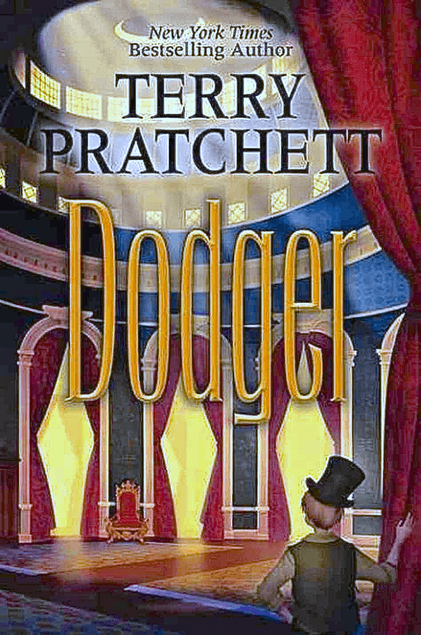
 I was excited to see that the library recently purchased a new book by one of my favorite authors, Sir Terry Pratchett. He wrote so many books for his comic fantasy Discworld series, that I was sure this new one was part of it. Upon further investigation, I learned that his 40th Discworld book, Raising Steam, will be published in the fall of 2013, but the new book, Dodger, is a horse of a different color.
The title made me think of a Dickens character called the "Artful Dodger." I was not surprised to learn that he is the main character of this book, but it was a surprise that this is not set in Discworld, but in the London of the early Victorian period.
Discworld books are hilarious parodies of all sorts of topics in our world: myths, history, literature, entertainment--you name it. The humor is still in Dodger, but Pratchett does attempt to avoid too much over-the-top anachronism and fantasy here. What's really cool is that Dodger encounters quite a few actual historical figures in the course of this story. It's easy to imagine Charles Dickens (one of the first people he meets) becoming inspired by a real "Dodger" like Pratchett's.
If you haven't read Charles Dickens' Oliver Twist, you should. It's a story about a boy, who escapes an orphanage and comes to London to seek his fortune. He joins a gang of young thieves, which includes the Artful Dodger. We eventually learn Oliver's true identity, but I don't want to give too much of the story away, to those unfamiliar with it.
Dickens was paid by the word, so this is a long book with a lot of description. It's generally considered to be appropriate for Grade 6 and up. The book is considered a classic; it has been made into several movies, and even a musical. I remember reading the book before I saw the movie version of the musical Oliver!, which was released in 1968. Comedians, and even TV commercials ("MORE PUDDING?"), have parodied a memorable scene in the workhouse, when little Oliver asks for more to eat, and the man is astonished at his audacity.
Dickens helped to expose some atrocious social conditions in his city. Pratchett explores these same conditions, but with a different point of view: Dodger's. Dodger is uneducated, but streetwise, and he has a tendency to think more philosophically than one might expect. For example, see this passage, right after Dodger has been informed that there are other planets besides Earth, and they all revolve around the sun:
"It seemed to Dodger that everything he was told by Solomon stuck him like a silver pin, which didn't hurt but filled him up with a sort of fuzz. He was beginning to see a world that stretched far beyond the tunnels beneath the streets--a world that was filled with things he didn't know. Things he hadn't even known he didn't know until now. Things he realized with a jolt that he wanted to know about. He wonder too if maybe Simplicity might be even more interested in a man who knew this kind of thing--and he realized how much he was looking forward to seeing her again."
Terry Pratchett's Dodger introduced me to a few new words, or at least, in the case of "geezer," a different meaning than I thought it had.
Discworld books are hilarious parodies of all sorts of topics in our world: myths, history, literature, entertainment--you name it. The humor is still in Dodger, but Pratchett does attempt to avoid too much over-the-top anachronism and fantasy here. What's really cool is that Dodger encounters quite a few actual historical figures in the course of this story. It's easy to imagine Charles Dickens (one of the first people he meets) becoming inspired by a real "Dodger" like Pratchett's.
If you haven't read Charles Dickens' Oliver Twist, you should. It's a story about a boy, who escapes an orphanage and comes to London to seek his fortune. He joins a gang of young thieves, which includes the Artful Dodger. We eventually learn Oliver's true identity, but I don't want to give too much of the story away, to those unfamiliar with it.
Dickens was paid by the word, so this is a long book with a lot of description. It's generally considered to be appropriate for Grade 6 and up. The book is considered a classic; it has been made into several movies, and even a musical. I remember reading the book before I saw the movie version of the musical Oliver!, which was released in 1968. Comedians, and even TV commercials ("MORE PUDDING?"), have parodied a memorable scene in the workhouse, when little Oliver asks for more to eat, and the man is astonished at his audacity.
 |
Image courtesy of El Bibliomata's photostream on Flickr.com. Some rights reserved. |
"It seemed to Dodger that everything he was told by Solomon stuck him like a silver pin, which didn't hurt but filled him up with a sort of fuzz. He was beginning to see a world that stretched far beyond the tunnels beneath the streets--a world that was filled with things he didn't know. Things he hadn't even known he didn't know until now. Things he realized with a jolt that he wanted to know about. He wonder too if maybe Simplicity might be even more interested in a man who knew this kind of thing--and he realized how much he was looking forward to seeing her again."
Terry Pratchett's Dodger introduced me to a few new words, or at least, in the case of "geezer," a different meaning than I thought it had.
- Tosher: this is a person who makes a living by finding lost or discarded things of value in the sewer. I couldn't even find this term in the Concise Oxford English Dictionary, but it does have the word "tosh," which means rubbish or nonsense.
- Geezer: The same dictionary defines this word the way I have understood it, a derogatory term for an old man, but it has a very different meaning in Dodger. Perhaps the words of the character Sharp Bob explain it the best: "A geezer, now, well, a geezer is somebody that everybody knows and he knows everybody, and maybe he knows something about everyone he knows that maybe you wished he didn't know. Um, and well, he's sharp, crafty, um, not exactly a thief but somehow things find their way into his hands. Doesn't mind a bit of mischief, and wears the street like an overcoat."
- Peeler: a police officer. This slang term comes from the name of Sir Robert Peel, the founder of the Metropolitan Police Department. I'm more familiar with "bobby" as the term for a police officer; this name also comes from Sir Robert Peel. Sir Robert is one of the historical figures Dodger encounters in this novel.


