Wednesday, May 7, 2014

Learning | The Parasol Protectorate.

Steampunk fans will enjoy reading Gail Carriger's books.


I learned about Ms. Carriger's books from a customer, who wholeheartedly recommended the Parasol Protectorate Series, also known as the Alexia Tarabotti Seriesto me.  

Soulless, Book 1 of the Parasol Protectorate Series
Quite honestly, she had me at "steampunk," but I was delighted when I started reading Soulless, the first book in the series. Carriger sets the series in a historical world that might have existed, if Victorian Society was interwoven with vampires, werewolves, ghosts and human beings. Queen Victoria has appointed a Shadow Council to oversee supernatural matters, and there is a Bureau of Unnatural Registry which keeps track of all of the werewolves and vampires in England. There are also plenty of interesting steam-powered machines used for detection, transportation, communication and warfare. (Including deadly mechanical ladybugs and porcupines!)  Alexia's parasol is her primary means of protection--and there are plenty of people who wish to see her dead in this series. History buffs will enjoy comparing the fantasy setting with the history/technology of the real world at the same time.

Alexia Tarabotti seems like a Jane Austen character. She would be a formidable force even without her preternatural status (in terms of this series, that means she was born without a soul; her touch will turn immortals human.) 

She keeps up with the latest scientific theory and technological developments. She's not afraid to protect herself...which explains why the first book opens on a scene where she accidentally killed a vampire, when she simply wanted to eat a few treacle tarts. 

Her mother and half-sisters are frivolous, mean-spirited women who are preoccupied with everything Alexia finds least interesting: who's engaged to whom, fashion, etc. 

Her best friend, Ivy, has horrible taste in hats; she may prone to malapropisms like, "persona au gratin," but she is not as foolish as she appears. 

I almost forgot to mention the great romance that transforms Miss Tarabotti into Lady Maccon by the end of the first book. If you've ever wondered about the challenges of marrying an earl who is a werewolf, look no further!

The Parasol Protectorate Series will appeal to fans of Jane Austen, P. G. Wodehouse, and Elizabeth Peters.  


Gail Carriger is writing more series to delight her fans:

Custard Protocol Series (sorry, you'll have to go to Link+ for this one)

Finishing School Series is a series for teens, set in the same fantasy Victorian Era as The Parasol Protectorate.

Soulless is the name of a manga series based on the Parasol Protectorate Series. I haven't seen it yet, but I will be looking for it.


Tuesday, May 6, 2014

4 Kids | Famous Celebrities Share Favorite Childhood Books

That's right! Today I will share with you some of the favorite childhood books of celebrities. Perhaps a title or two will strike your fancy and you'll pick up a copy at your next trip to the Library! I hope you do!

But why, you may wonder, am I interested in what famous people read as children? 

I just came across a new-ish non-fiction book entitled The Book That Will Make You Love Books, by Francoize Boucher. I must admit: the title very much intrigued me. So I opened it up and immediately started laughing out loud. It's a quick, cartoon-filled book filled with little tidbits about the benefits of reading:

If you love a book you can read it over and over thousands of times, but, if you love chocolate, you can only eat the same bar once.

Sometimes, a book is like a lamp: it sheds light on life's great questions.

Although there is a lot to chuckle at, there is also some very valid information about the benefits of reading. And by that, I mean reading a lot! Check it out and read it for yourself!!

In the meantime, as promised, favorite childhood books of famous celebrities. And by famous celebrities, I do mean famous local celebrities. You knew that, right?


As a child, Lori Gilbert, Record Columnist, loved A Fly Went By by Marshall McClintock because of the pictures and the way the story repeats. Hint: You'll find this one in the Easy Reader section!


Another celebrity -- Bill Maxwell, Archives Manager at the Bank of Stockton and longtime Friends of the Stockton Public Library Board Member -- loved The Story of Ferdinand by Munro Leaf because of illustrations like this:


Our last celebrity is none other than Chris Freeman, our City Librarian. Mr. Freeman's favorite childhood book is Magician by Raymond E. Feist, a Tolkien-esque saga that features two pre-teen boys (instead of Hobbits) in a fast-paced and fantastical world full of elves, dwarves, "dark" elves, and (even!) aliens! Man oh man I want to read that one! That title was actually published in two volumes here in the good ole United States. And we have one of them: Magician, Master.

So let's get reading! What do you say? Thanks to our celebrities, we've got some good recommendations!

Happy Reading!


Monday, May 5, 2014

Just Life| Beating the Blues

We have this wonderful newsletter at Chavez reference called the " Harvard Health letters". In their April 2014 issue, I came across this article called " Drug free options to fight depression."

According to this article, one of the ways to fight depression is by exercising.

Both high intensity exercises and low intensity exercises can help alleviate depression.

High intensity exercises increase the releasing of feel good hormones called endorphins.

Low intensity exercises cause the growth of new nerve cells and nerve connections in the hippocampus; which is the mood regulating area of the brain.  

The benefits of low intensity exercises start appearing after a few weeks of low intensity exercising.

Since one of the side effects of depression is a lack of motivation, the article suggests forcing yourself to walk for only 5 minutes/day for a week. Then try to add another 5 minutes the next week and so on, until you reach the goal of walking 20-30 minutes a day. 

If you are not the exercising type, eating dark chocolate can help fight the blues as well.

Signing off until next Monday- Panteha


Saturday, May 3, 2014

Teens Only | It's Probably On Your School Reading List

It being Farewell to Manzanar, Jeanne Wakatsuki Houston's 1973 memoir describing her family's experiences before, during and after their imprisonment at the Manzanar Concentration Camp. You are all aware, smart students that you are, of how the United States government imprisoned Japanese Americans in internment camps during World War II because of their potential threat to national security. I'm reading it right now, which is rather fitting because the first week of May is Asian Pacific American Heritage week. This date was chosen because two important anniversaries occurred during this time: the arrival of the first Japanese immigrants in America in 1843 and the completion of the Transcontinental Railroad (by many Chinese laborers) on May 10, 1869.
 
But back to the book. I'll finish it today because it's only 203 pages. If it's important to you to know our history, and to develop empathy through understanding the plight of others, then I highly recommend you pick up this book. Seriously. At some point it will show up on a school reading list.
 
Jeanne's father was actually sent to an internment camp in North Dakota before being reunited with his family at Manzanar. Here is what she writes about her father's time there:
 
Papa never said more than three or four sentences about his nine months at Fort Lincoln. Few men who spent time there will talk about it more than that. Not because of the physical hardships: he had been through worse times on fishing trips down the coast of Mexico. It was the charge of disloyalty. For a man raised in Japan, there was no greater disgrace. And it was the humiliation. It brought him face to face with his own vulnerability, his own powerlessness. He had no rights, no home, no control over his own life.
 
I'll just let you think about those words for a while. And I hope that you'll join me in reading this important book.
 
Empathy through understanding.
 
And by the way, the Chavez Library is looking for teen volunteers (age 14 and older) to be part of Summer Book Buddies -- a program that helps children entering the 1st, 2nd and 3rd grades with reading. Join us! You will feel really, really great about giving back to your community. Training is Saturday, June 7 from 10 am until 12 pm. Questions? Call (209) 937-7012.
 
Happy reading!


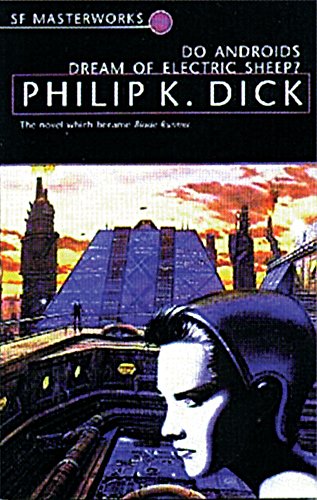
Books On Film | Do Androids Dream of Electric Sheep?

http://ibistro2.stockton.lib.ca.us/uhtbin/cgisirsi/x/0/0/57/5/3?searchdata1=64214{CKEY}&searchfield1=GENERAL^SUBJECT^GENERAL^^&user_id=WEBSERVERHere's one last adaptation for the classic science fiction lovers.

Do Androids Dream of Electric Sheep? by Philip K. Dick was published in 1968. The novel is set in a post-apocalyptic earth, most of which has been destroyed by nuclear war. Animals are prized because of their rarity and androids are used as slave workers on the planetary outposts where most humans live. 

http://ibistro2.stockton.lib.ca.us/uhtbin/cgisirsi/x/0/0/57/5/3?searchdata1=3608{CKEY}&searchfield1=GENERAL^SUBJECT^GENERAL^^&user_id=WEBSERVERIndistinguishable from humans on the outside, many androids try to escape to earth and pass as human. The novel follows a day in the life of Rick Deckard, a bounty hunter, on the hunt for escaped androids who are distinguished from humans using a polygraph-like empathy test called the Voigt-Kampf.

Ridley Scott adapted the novel into a feature film called Blade Runner in 1982. The film follows the premise of the books and keeps a lot of characters and elements in place, but diverges from the source material quite a bit. So, don't watch the film expecting. However, it's considered a scifi cult classic and was responsible for bringing Philip K. Dick's work to the attention of film studios.

Covers courtesy of LibraryThing.

Tuesday, April 29, 2014

4 Kids | Let's Play Ball

It's baseball time again -- loud applause here, please -- and so for you dear readers who share my love of this sport, let's take a moment to explore what might be an unknown part of our beloved sport's history.

But first, a little explanation: many of you may be hearing things like "critical thinking," "common core," and "informational text" in school these days. There are lots of changes going on in terms of what your teachers are teaching. But the great news is that non-fiction is getting some long overdue appreciation. So every week I'll be sharing non-fiction books with you. That's right: Non-Fiction! And I promise to share really great stuff. Informational stuff that's told in such a great way you'll think you're reading fiction! But you'll actually be learning something too. Trust me: this is going to be fun!

Back to baseball.
I just read Barbed Wire Baseball by Marissa Moss and Yuko Shimizu. It's a short book that tells the story of Kenichi "Zeni" Zenimura. Zeni loved baseball. And he was really good at it. He played in the Fresno Nisei League and the Fresno Twilight League, and in fact, when the New York Yankees came to Fresno to play an exhibition game, Zeni was one of a few players asked to play with them! There's even a picture of Zeni standing with baseball greats Babe Ruth and Lou Gehrig.
But here's where the story takes a sad turn: When the Japanese attacked Pearl Harbor in 1941, 120,000 Japanese Americans living in the United States were sent to internment camps (think prison, not fun camp) because they were considered "possible spies." Zeni and his family were sent to just such a camp in Gila River, Arizona. It was a dry desert.
Even in these dire circumstances, Zeni did not lose his love of baseball. He decided to build a baseball field right there in the desert! Grass, bleachers, and chalk lines made out of flour -- he did it! And the first game played there was watched by 6,000 people!
It's no wonder that Zeni is considered the father of Japanese American baseball. Amazing what one person can accomplish, don't you think?
This is a non-fiction book, by the way. It reminds me of another great book on the same subject: Bat 6 by Virginia Euwer Wolfe. Although Wolfe's book is fiction, its story of girls' softball teams in Oregon in the aftermath of Pearl Harbor and Japanese-Americans being sent to internment camps is very compelling.
I always look for a lesson whenever I read a book -- something I can take and apply in my everyday life.
I have a copy of Bat 6 autographed by the author. Her words: Fair play for (and from) all of us!
Play ball! And happy reading!


Monday, April 28, 2014

Just Life | Home Remedies!

I always wonder if home remedies have any merits. In my family, it seems like we can cure almost any ailment with two things: salt water and sweet tea.

For example, as soon as my dad catches a cold or gets a sore throat, he starts gargling warm salt water.

For any types of tummy problems, we drink hot sweet tea.

To verify the medical benefits of gargling salt water, I checked the Alternative Health Watch Database. I was pleasantly surprised to find articles about its effectiveness. So, at least one of our home remedies has a scientific stamp of approval. 

I still haven't researched the merit of sweet tea yet, but you never know.

So, the next time you catch a cold or sore throat, give salt water a chance.

While you are at it, check out a home remedy book from your local library.

The country almanac of home remedies

Mayo Clinic book of home remedies  

Alternative cures 

Signing off until next Monday- Panteha